 Arrow
Arrow 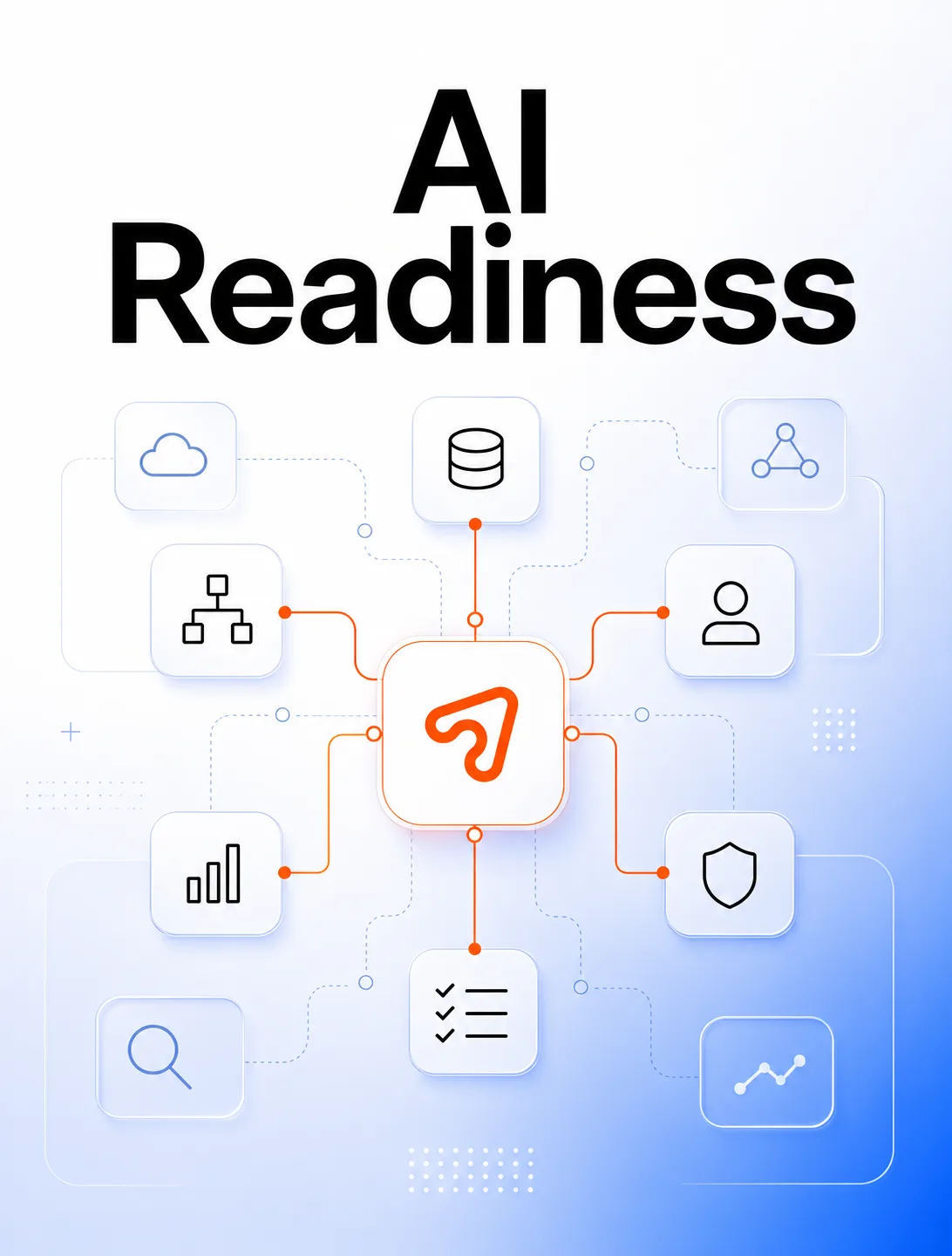
AI readiness means the company has the operating foundation required to deploy useful AI: trusted knowledge, clear processes, connected tools, governance, and a feedback loop. Without that foundation, every AI project becomes another disconnected experiment.
Companies do not fail because AI is weak. They fail because the business context is weak.
A model can only be as useful as the system around it. If the CRM is incomplete, the knowledge base is outdated, the team has no escalation rules, and the workflow still depends on manual handoffs, AI will produce impressive demos without operational impact.
That is why Arrow AI treats AI readiness as infrastructure. Before building agents, automation, GEO content systems, or customer-facing interfaces, we identify the pieces that need to be cleaned, connected, and governed.
The six layers to prepare before scaling AI.
Clean data
AI needs reliable customer, product, service, pricing, and operational data before it can produce dependable outputs.
Approved knowledge
Documents, FAQs, policies, service pages, case studies, and internal playbooks need ownership and update rules.
Workflow maps
The company needs to know where leads, tasks, requests, approvals, and follow-ups actually move.
Connected tools
HubSpot, Shopify, Slack, calendars, forms, dashboards, and internal systems should pass context instead of creating copy-paste work.
Governance
Permissions, escalation rules, logs, human validation, and approved actions turn AI from a risky shortcut into a controlled system.
Measurement
Teams need to track response time, lead quality, conversion, support load, content velocity, and workflow completion.
Readiness also affects whether AI engines can understand your company.
AI readiness is not only internal. Public content matters too. If your website does not clearly define what you do, who you serve, what proof you have, and how your services connect, AI search engines will struggle to cite you. That is where GEO becomes part of the infrastructure.
Strong companies connect both sides: GEO visibility so AI engines can find them, and an AI operating layer so teams can handle the work that follows.
Build the foundation, then scale the system.
Put it into practice
Reading is step one. The audit is step two.
See how AI engines describe your brand today — free, in two minutes.