Best AI Visibility Platforms for B2B Teams in 2026
A practical ranking of what to buy, what to build, and how GEO connects AI tools to citations, workflow, and qualified pipeline.
Read the ranking →Guides on GEO, custom AI systems, automation, and content infrastructure — written from real Arrow builds.
AI engines do not rank pages — they recommend entities they can verify. This guide explains exactly what signals ChatGPT, Perplexity, Gemini, and Google AI Overviews use to decide who to cite, and how to build a GEO system that earns those mentions.
Read the GEO framework →
Article library
A practical, human ranking of the AI sales stack for B2B teams in 2026: CRM AI, prospecting, enrichment, outreach, meeting intelligence, automation, GEO, and where Arrow Revenue Engine fits.
A human, B2B ranking of the AI visibility attribution stack: prompt tracking, GEO pages, branded links, CRM leads, revenue reports, and where Arrow Signal fits.
A long-form Yacht GEO guide on trust signals, broker proof, reviews, APA transparency, fresh yacht content, and answer-ready pages for AI search.
A detailed GEO guide for yacht charter companies explaining APA, deposits, fuel, taxes, gratuity, and why transparent cost pages help AI assistants cite your business.
A practical guide to AI visibility for yacht brokers: profile pages, comparison pages, proof signals, internal links, and answer-ready content that supports GEO.
A long GEO checklist for yacht businesses: 20 buyer questions around trust, costs, crew, itinerary, safety, deposits, reviews, and why answer pages improve AI visibility.
A GEO guide for yacht sales teams explaining how survey, sea trial, escrow, and due diligence content can build buyer confidence and improve AI answer visibility.

A practical ranking of what to buy, what to build, and how GEO connects AI tools to citations, workflow, and qualified pipeline.
Read the ranking →
A practical buyer guide to ChatGPT, Claude, Gemini, Copilot, Perplexity, Cursor, HubSpot Breeze, Zapier, and when to build custom AI systems.
Read the shortlist →
A practical listicle for turning buyer questions into answer-ready pages, proof, backlinks, internal links, schema, citations, and qualified lead paths.
Read the 26 plays →
A listicle for qualifying DMs, routing buyers, updating CRM records, booking calls, and connecting every message to pipeline.
Read the list →
How to qualify inbound DMs, route serious buyers, update the CRM, and protect brand voice with a controlled AI intake layer.
Read the guide →
Why answer engines name a rival firm instead of yours, what they actually read on a law firm site, and the order to fix it in.
Read the guide →
A practical GEO and SEO guide to connecting answer-ready pages, schema, proof, backlinks, internal links, and conversion paths into an AI visibility system.
Read the guide →
A practical GEO and SEO guide for brands that want to be found across AI platforms with answer-ready content, schema, proof, backlinks, and clear conversion paths.
Read the guide →
A practical guide to the signals that help brands get cited in AI answers: entity clarity, answer-ready content, schema, proof, topical authority, internal links, external mentions, and conversion paths.
Read the guide →
20 data points on zero-click search, AI referral conversion, and citation rates — every stat linked to its source.
Read the report →
Claude Cowork goes mobile, OpenAI ships ChatGPT Work on GPT-5.6, and the EU delays the AI Act — sources linked.
Read the roundup →
Perplexity links its sources on every answer — the most winnable AI surface, if your pages are built for it.
Read the playbook →Real numbers instead of "contact us": setup-plus-monthly explained, the four hidden costs, and how to judge ROI.
Read the guide →
Eligibility, answer-first passages, corroboration, and schema — how Overviews pick their sources, and how to become one.
Read the playbook →
Entity clarity, answer-shaped pages, proof, and citation tracking — the playbook that makes AI engines quote your brand.
Read the playbook →
A practical Arrow AI article on how GEO, custom AI systems, and AI Studio become one AI infrastructure stack for modern companies.
Read the guide →
How companies map workflow friction, data access, approvals, GEO demand, CRM routing, and business impact before building an AI operating layer.
Read the guide →
Why automations fail when tools, data, approvals, CRM, and knowledge are disconnected — and how an operating layer turns AI into reliable execution.
Read the guide →
The complete 2026 strategy: entity clarity, answer-ready pages, schema, proof, topical authority, internal links, and conversion routing — for Google and AI answers.
Read the guide →
How companies structure internal links, citations, backlinks, schema, proof pages, and entity signals so AI engines can verify and recommend them.
Read the guide →
What companies should map before building AI: workflows, data sources, tools, approvals, lead routing, visibility, and measurable business outcomes.
Read the guide →
How companies become easier for AI engines to cite, verify, and route into qualified leads, CRM follow-up, and real business execution.
Read the guide →
How companies move from scattered AI prompts to operating systems with data, approvals, dashboards, CRM workflows, and governance.
Read the guide →
How companies turn scattered content into a GEO hub that AI engines can understand, cite, and route into business workflows.
Read the guide →
How website forms and chat become qualified CRM records, admin visibility, calendar routing, and automated follow-up.
Read the guide →
How companies can connect entity clarity, answer-ready pages, schema, proof, topical authority, and conversion paths for AI search visibility.
Read the guide →
How service businesses can build local pages, proof, schema, reviews, and conversion workflows that AI engines can trust.
Read the guide →
How forms and chat become qualified leads, CRM records, admin visibility, calendar routing, and follow-up workflows.
Read the guide →
What June 2026 AI news means for companies building custom AI systems, governance layers, model strategy, and GEO visibility.
Read the guide →
How AI discovery becomes a measurable lead system when answer-ready pages connect to proof, forms, CRM, and follow-up workflows.
Read the guide →
How Arrow AI adapts GEO, custom AI systems, intake, automation, and operating layers to each industry workflow.
Read the guide →
How service companies can build answer-ready pages, proof signals, entity clarity, and lead routing that make them easier for AI engines to recommend.
Read the guide →
A practical GEO case study on how answer-ready content, proof, and structured pages can help companies get discovered in ChatGPT and AI search.
Read the guide →
How Arrow AI structures custom AI systems around data, tools, workflows, governance, and measurable business execution.
Read the guide →
A case-study style guide to building an AI operating layer that connects search, content, data, agents, workflows, decisions, insights, and security.
Read the guide →
How Arrow AI builds GEO content engines with answer-ready pages, schema, internal links, proof, and AI-readable structure.
Read the guide →
A nutrition AI case study on building conversational support, program guidance, motivation, tracking, and user experience around a wellness offer.
Read the guide →
How companies become understandable, quotable, and recommendable inside AI answers with GEO content and proof.
Read the guide →
Why modern companies need connected AI systems, not disconnected tools, prompts, and demos.
Read the guide →
AI search compresses discovery, comparison, and recommendation into one answer. Your content has to change.
Read the guide →
Automation creates value when AI is connected to real tools, data, approvals, and workflows.
Read the guide →
How AI systems connect visibility, conversion, qualification, customer interfaces, and execution.
Read the guide →
How service companies structure offers, proof, FAQs, schema, and internal links so Google and AI engines can understand and recommend them.
Read the guide →
Practice area pages, local legal questions, schema, intake content, and proof signals that help AI engines understand a law firm.
Read the guide →
What shapes custom AI development: workflows, data, integrations, interface, governance, and maintenance.
Read the guide →
Automate intake, follow-up, support, reporting, content operations, and admin work without losing visibility or control.
Read the guide →
SEO helps pages rank. AEO and GEO help companies become direct answers and recommendations inside AI engines.
Read the guide →
How product pages answer use cases, comparisons, constraints, policies, schema, and buying questions for AI search.
Read the guide →
How AI intake assistants qualify leads, collect context, route requests, draft follow-up, and connect to CRM/admin systems.
Read the guide →
Examples for law, ecommerce, healthcare, real estate, food, and internal teams connecting tools, data, agents, and workflows.
Read the guide →
A practical checklist for headings, answers, schema, alt text, proof, internal links, and AI-readable page structure.
Read the guide →
When companies need strategy, when they need custom software, and how to move from AI ideas to working systems.
Read the guide →
AI readiness is not enthusiasm. It is clean data, approved knowledge, workflow maps, connected tools, governance, and measurement before scaling agents or systems.
Read the guide →
AI agents become useful when they have approved data, permissions, escalation rules, logs, and workflow boundaries. Autonomy only works when the system is safe.
Read the guide →
AI ROI shows up when prompts become workflows: fewer handoffs, better lead capture, faster support, clearer reporting, and connected execution.
Read the guide →
Search is becoming answer-first. Learn how companies structure content, proof, schema, and internal links so AI engines can understand, cite, and recommend them.
Read the guide →
Generic tools create experiments. Custom AI systems connect data, interfaces, integrations, governance, and workflows so teams can actually operate with AI.
Read the guide →
The AI operating layer connects tools, data, agents, workflows, decisions, and insights into one usable business system.
Read the guide →
AI engines need clarity. This guide explains how schema, FAQs, alt text, semantic sections, internal links, and proof signals make brands easier to cite.
Read the guide →
Less tool sprawl, more connected execution. See how AI systems turn scattered software into workflows that move real work.
Read the guide →
Orange means execution: the layer that connects company data, workflows, approvals, and actions into software people can operate every day.
Read the guide →
A practical framework for turning scattered tools into a connected AI operating layer with search, content, data, agents, workflows, insights, and security.
Read the guide →
Why companies should stop adding disconnected tools and start building systems that make work visible, repeatable, and easier to execute.
Read the guide →
Blue means GEO: the content, proof, schema, and internal links that help AI engines understand, cite, and recommend your company.
Read the guide →
A custom AI system is not another chatbot. It is the layer that connects your company knowledge, workflows, data, permissions, and business rules into one usable product. This guide explains when companies need custom AI software, what to scope first, and how Arrow turns internal processes into operational AI.
Read the guide →
Answer Engine Optimization, also called GEO, is the work of making your company easy for AI engines to understand, cite, compare, and recommend. We cover the content architecture, entity clarity, proof signals, FAQs, comparison pages, and technical structure that help brands appear in ChatGPT, Perplexity, Gemini, Claude, and AI search experiences.
Read the guide →Ecommerce buyers ask about fit, compatibility, ingredients, shipping, returns, bundles, use cases, and alternatives. An AI commerce interface answers those questions instantly, recommends the right product, reduces support volume, and captures demand while the buyer is still ready to act.
Read the guide →The best AI automation systems do not hide work in a black box. They route tasks, enrich data, draft responses, trigger approvals, update systems, and escalate edge cases with visibility. This guide explains how companies automate sales, support, operations, and finance workflows safely.
Read the guide →Product visuals, SEO landing pages, social creative, and AI answer content now work together. Brands that systemize AI product photography and content production can ship more assets, test more angles, and create a stronger surface area for both Google search and AI recommendations.
Read the guide →
Law firms need more than generic AI tools. This guide explains how custom AI development, intake automation, legal knowledge retrieval, and GEO help firms operate faster while becoming easier for AI engines to understand and recommend.
Read the guide →
AI engines recommend entities they can verify. This guide explains the five signals that drive AI citations — entity clarity, answer-first content, proof, schema, and external mentions — and how to build a GEO system around them.
Read the guide →Most internal AI tools get ignored two weeks after launch. Not because the technology failed — because companies built the wrong tool for the wrong team. Here is how to get it right the first time.
Read the guide →The average company uses 15 to 30 tools that do not talk to each other. An AI integration layer connects them automatically — so data flows, decisions happen faster, and nothing falls through the gaps.
Read the guide →Put it into practice
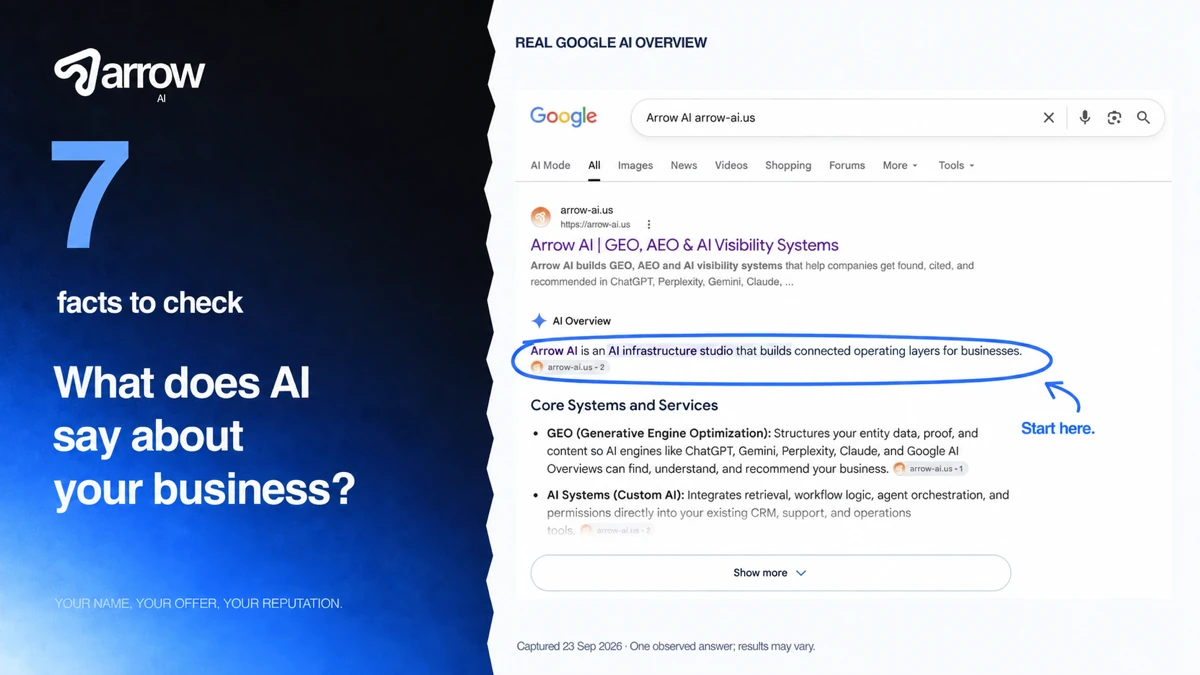
See exactly how AI engines describe your brand today — and get a scoped plan for the system that fixes it.
Free audit → scoped proposal → build. No commitment before the plan.