 Arrow
Arrow 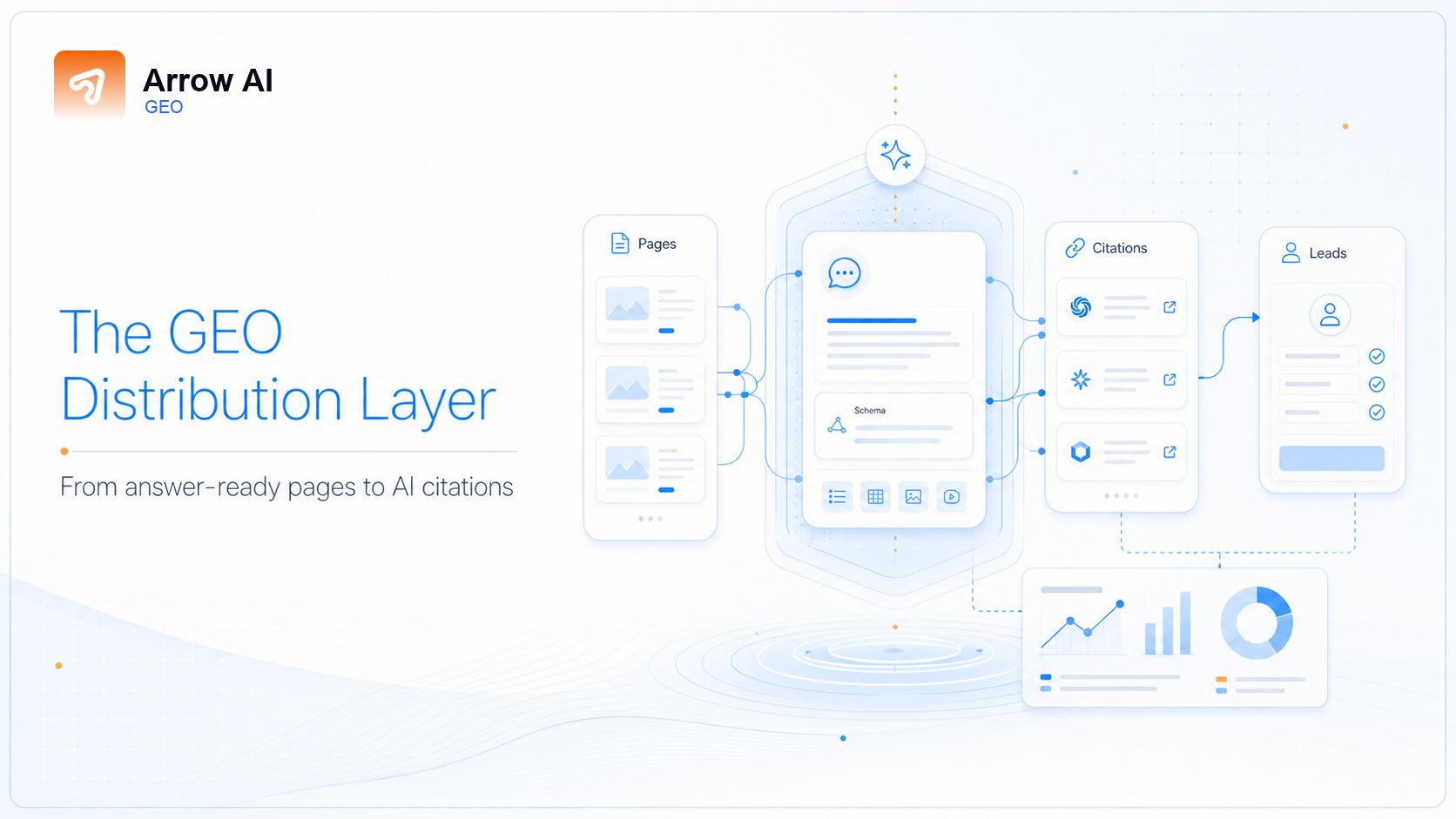
A GEO distribution layer is the connected system of answer-ready pages, entity clarity, schema, proof, internal links, external mentions, and conversion paths that makes a company easy for AI engines to understand, verify, and cite. It is not one viral article — it is infrastructure.
GEO, or Generative Engine Optimization, is not a trick for “ranking in ChatGPT.” It is a system for making a company easier to understand, compare, verify, and cite. The companies that win AI visibility usually do not rely on one viral article. They build a connected layer of pages, evidence, schema, internal links, and external mentions.
What is a GEO distribution layer?
A GEO distribution layer is the public knowledge infrastructure around a company. It includes the pages buyers read, the pages AI systems crawl, the proof that validates claims, and the conversion paths that turn a mention into a meeting. Traditional SEO often starts with keywords. GEO starts with buyer questions: “Which provider should I choose?”, “What are the alternatives?”, “What does it cost?”, “Who is best for my industry?”, and “What proof exists?”
This is why pages such as how to get your brand cited by ChatGPT, how to get cited by Perplexity, and the Google AI Overviews playbook matter. They do not replace SEO. They extend it into the answer layer.
The architecture: pages, entities, schema, citations, leads
A strong GEO system has four connected parts. Each part should be simple enough for a buyer to trust and structured enough for answer engines to parse.
For implementation, Arrow AI usually connects these pages to a broader content map: Answer Engine Optimization, the SEO + GEO visibility stack, AI citations and internal links, and the machine-readable content checklist.
Why backlinks and external mentions still matter
AI answers are not built only from your website. They are influenced by the wider web context around your company: partner mentions, directories, public profiles, press, comparison pages, review surfaces, podcasts, social profiles, documentation, and product pages. Quality matters more than volume.
Useful external references include Google’s own guidance on SEO fundamentals, structured data, the open vocabulary at Schema.org, and Google’s explanation of how Search works. These are not shortcuts. They are baseline trust and crawlability signals.
For a company, that means building a backlink plan around relevance: client case pages, industry articles, founder profiles, partner directories, product integrations, media mentions, and expert explainers. The goal is not to spam links. The goal is to make the company’s expertise easy to confirm.
What to measure in GEO
The mistake is measuring only traffic. GEO should be measured like a visibility and revenue system. A useful dashboard tracks priority prompts, cited pages, competitors named in the same answer, source gaps, freshness, internal link coverage, referral sessions, audit submissions, booked calls, and CRM outcomes.
This is where Arrow AI’s approach connects content with systems. If a page starts appearing for a high-intent prompt, the next question is operational: does the page route the visitor to the right offer, ask the right question, sync the lead to HubSpot, and trigger follow-up?
A practical implementation playbook
- Map prompts: list the questions buyers ask ChatGPT, Perplexity, Gemini, Google AI, and sales teams.
- Build page clusters: create service, industry, comparison, proof, pricing, integration, and FAQ pages.
- Add schema: use Article, FAQPage, Organization, BreadcrumbList, Service, and relevant structured data.
- Connect internal links: every guide should point to core service pages, related guides, and conversion paths.
- Earn external proof: publish useful assets, case studies, profiles, and partner mentions that support entity trust.
- Route demand: connect CTAs to the free audit, the GEO check, and sales follow-up.
- Refresh monthly: update pages when pricing, offers, product features, integrations, or market language changes.
The Arrow read
Visibility is infrastructure, not a content calendar.
The new distribution layer is not only search traffic. It connects GEO visibility, custom AI systems, case studies, lead capture, CRM routing, and sales follow-up. The page has to be useful to humans and legible to machines. If you want this mapped, start with the Arrow AI audit.