 Arrow
Arrow 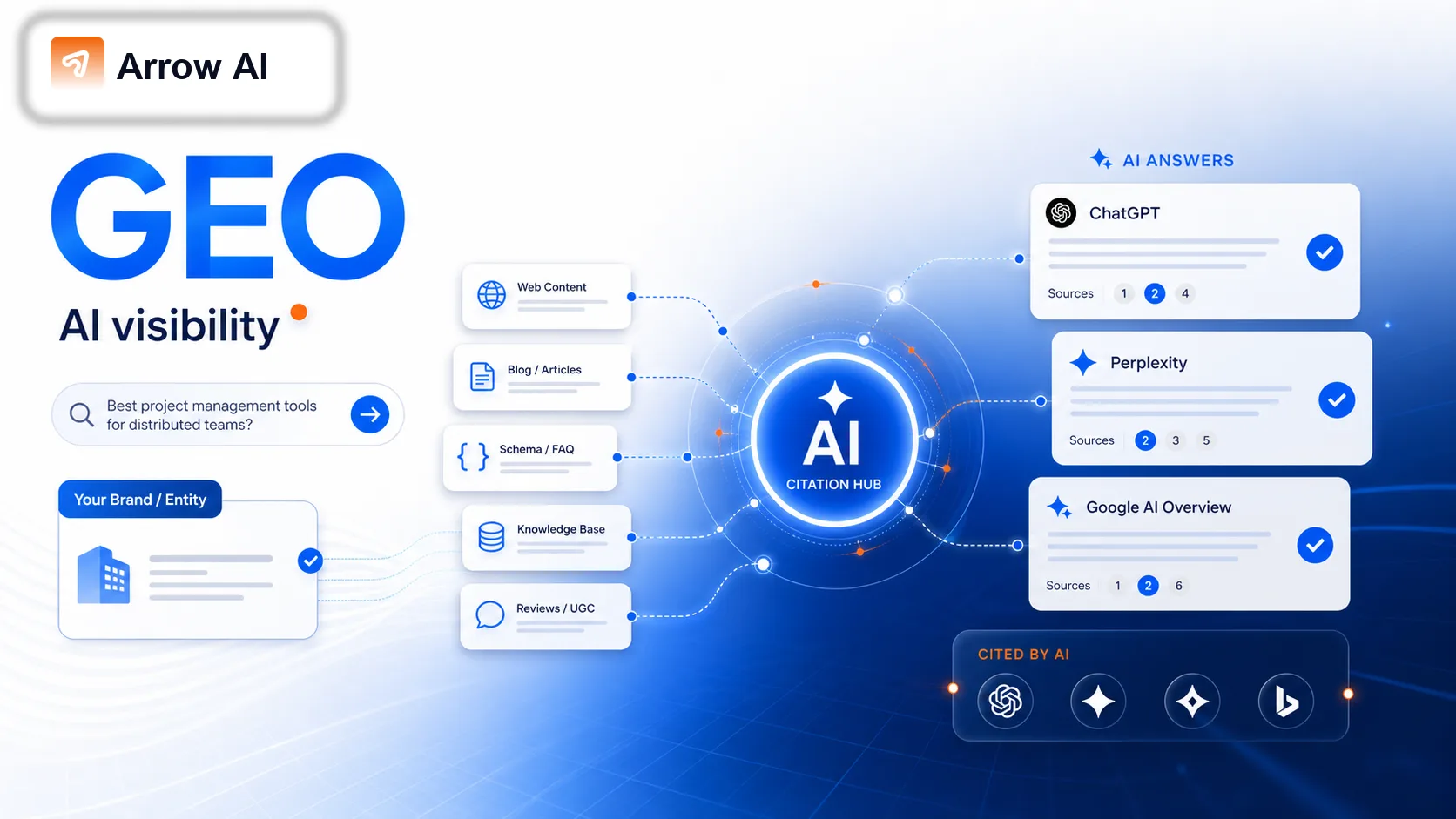
GEO ranking signals are the proof, structure, links, and language patterns that help AI engines decide whether your company is a reliable answer. A page does not win because it says “best.” It wins when the brand, service, proof, schema, and surrounding web mentions make the answer easy to verify.
What are GEO ranking signals?
GEO stands for Generative Engine Optimization. It is the work of making a company easier for AI systems to understand, cite, compare, and recommend. SEO still matters because pages need to be crawlable, indexable, and authoritative. GEO adds another requirement: the content must be machine-readable enough for an AI answer to use it confidently.
An AI engine is not only looking for keywords. It is trying to answer a question with a defensible response. That means it needs evidence. The stronger your entity, proof, and page structure are, the easier it is for the model to include you in an answer.
For a broader foundation, read Arrow AI’s guides on Answer Engine Optimization, getting cited by ChatGPT, and getting cited by Perplexity.
The eight GEO ranking signals that matter
Signal 1: entity clarity
AI systems cite entities they can identify. If your website uses inconsistent names, vague descriptions, or changing service labels, the model has to guess. A strong GEO page repeats the company name, service category, audience, location, and use cases consistently.
For Arrow AI, that means consistent language around GEO, Custom AI Systems, and AI Studio. For a law firm, it means naming practice areas, locations, attorney credentials, client types, and intake process. For a real estate or DPE business, it means naming cities, services, proof, reviews, and decision-stage questions.
Signal 2: answer-ready content
Most websites are written for a visitor who is already on the page. AI answer engines need content that can be lifted into a response. The format matters: short definitions, direct comparisons, numbered steps, FAQs, pros and cons, pricing context, eligibility rules, and use-case explanations.
Good answer-ready content says: “Here is the question, here is the direct answer, here is the supporting detail, here is the proof, and here is the next page to read.” That structure helps both search engines and AI systems.
Signal 3: schema and machine-readable structure
Schema is not a magic ranking button. It is a translation layer. It helps machines classify the page. A GEO article should include Article or BlogPosting schema. A service page should include Service schema. A FAQ section should include FAQPage schema. A company site should include Organization schema and social profiles.
Use official references like Schema.org and Google Search Central to keep markup clean. The point is not to add markup everywhere. The point is to make the most important facts unambiguous.
Signal 4: proof pages and case studies
AI systems need evidence to justify recommendations. A service page that claims “we help companies get found in AI” is weaker than a service page connected to a case study, an audit methodology, screenshots, before/after queries, and a clear process.
This is why case studies such as the France DPE GEO example matter. They show a concrete commercial context: a local service category, clear intent, AI-assisted discovery, and a path from visibility to qualified demand.
Signal 5: topical authority and internal links
One article is not a GEO strategy. AI engines evaluate surrounding context. If your site has one page about AI visibility but no pages about prompts, schema, case studies, service categories, pricing, FAQs, or industries, the site looks thin.
The fix is a topical map. Build pages that answer the full decision path: what the topic is, how it works, who it is for, what it costs, what examples exist, what risks matter, and how to start. Then connect them with internal links. Start with the SEO + GEO visibility stack, local GEO for service businesses, and the machine-readable content checklist.
The practical GEO workflow
- Map priority prompts. List the questions buyers ask AI before buying: “best provider for…”, “how much does… cost”, “compare…”, “who can help with…”.
- Audit current answers. Test ChatGPT, Perplexity, Gemini, Claude, and Google AI experiences. Record whether the brand appears, how it is described, and which sources are cited.
- Build answer pages. Create pages that answer each buying question directly and connect them to service, industry, pricing, FAQ, and proof pages.
- Add schema. Use structured data to clarify the page type, entity, service, author, image, breadcrumbs, and FAQs.
- Strengthen proof. Add case studies, outcomes, images, reviews, quotes, and third-party mentions.
- Distribute externally. Share the page on LinkedIn, Instagram, YouTube, TikTok, directories, partner pages, and newsletters so the web graph sees activity around the topic.
- Measure monthly. Track prompts, mentions, citations, traffic, leads, and whether AI answers describe the company correctly.
How to measure GEO performance
GEO measurement is not only traffic. Some AI answers influence buyers without sending a click. Track five layers:
- Visibility: Does the brand appear for target prompts?
- Accuracy: Does the answer describe the offer correctly?
- Citations: Which pages and external sources are cited?
- Comparison: Which competitors appear in the same answers?
- Demand: Are leads mentioning ChatGPT, Perplexity, Google AI Overviews, or “I found you through AI”?
Arrow AI uses this logic inside its GEO audit and connects it to custom AI systems when the visibility layer needs to route leads, qualify prospects, or update a CRM.
External signals and backlinks
External links and mentions still matter because AI systems cross-check the broader web. Strong signals include company profiles, LinkedIn posts, YouTube descriptions, partner pages, directories, press mentions, case study PDFs, podcast pages, and reputable industry references.
Useful reference sources for teams building GEO programs include Google’s SEO Starter Guide, FAQPage schema, BlogPosting schema, and Organization schema. These are not shortcuts; they are standards that support clearer machine interpretation.
The Arrow read
The brands AI engines can verify are the brands they cite.
Every signal here points the same way: make the entity, the answer, and the proof easy for machines to check. That is what Arrow GEO builds — start with the free GEO audit to see where you stand today.