 Arrow
Arrow 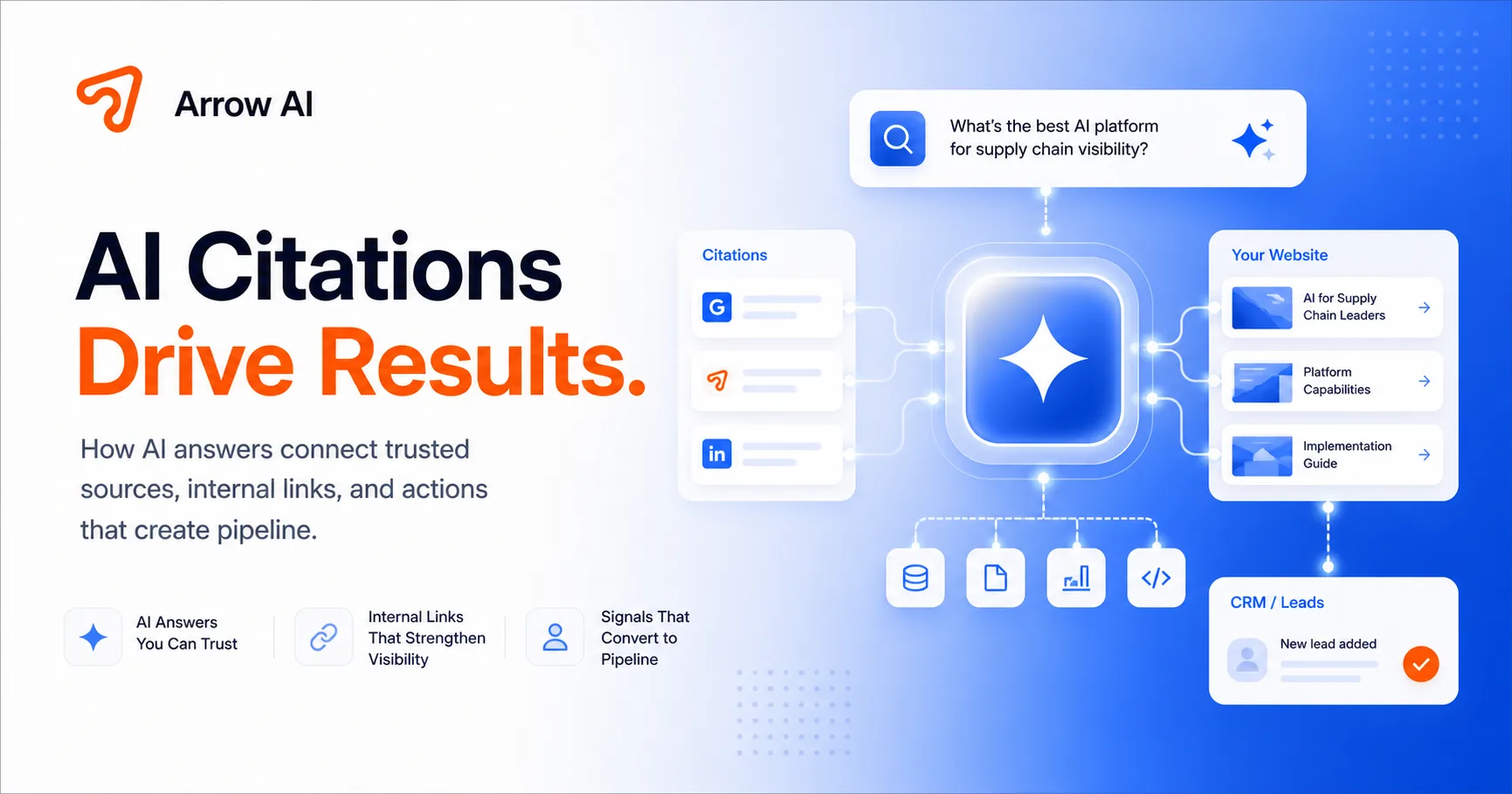
AI answers are assembled from signals, not read like a homepage.
When a buyer asks an AI system for a recommendation, the model needs to understand who you are, what you do, who you serve, what proof supports the claim, and which page should be cited. If that context is scattered, the brand becomes harder to recommend.
That is why Arrow AI GEO treats content as infrastructure. A strong answer-ready page should point to related proof, use cases, service pages, industry pages, and external authority sources.
Internal links tell AI systems which pages explain the business.
Internal links create a map. They connect your offer page to your proof pages, blog articles, industry pages, case studies, and conversion paths. This helps both search crawlers and answer engines understand the relationship between topics.
For example, a GEO article should naturally connect to how to rank in AI search, GEO content hubs, SEO + GEO visibility stacks, case studies, and the main GEO offer.
External references help define authority and context.
Backlinks are not just an SEO tactic. In an AI search environment, external references help anchor your brand and your claims in a broader knowledge graph.
Useful external references include documentation and standards such as Google Search Central, Schema.org, JSON-LD, Sitemaps.org, and robots.txt guidance.
For operational AI systems, credible references can also include product ecosystems like OpenAI for business, Claude, Google AI, Microsoft AI, Salesforce AI, HubSpot AI, Zapier AI, Vercel AI, and Cloudflare AI.
Every page should make the entity unmistakable.
Answer engines need clean entity signals. The company name, offer, market, use cases, proof, service area, and next step should be consistent across the site.
For Arrow AI, that means consistently connecting the core ideas: custom AI systems, GEO visibility, industry operating layers, AI lead intake, custom AI ops, and AI audit readiness.
AI systems need proof, not only positioning.
Proof pages make claims easier to verify. That can include case studies, before-after workflows, screenshots, process breakdowns, industry examples, outcome summaries, and implementation notes.
Internal proof clusters can connect articles like the France DPE GEO case study, AI visibility to qualified leads, AI operating layer case study, and AI nutrition companion case study.
Structured data turns content into machine-readable context.
Schema does not replace strong content, but it helps machines interpret the page. BlogPosting, Organization, BreadcrumbList, FAQPage, Article, Product, Service, and LocalBusiness schema can all help depending on the page.
A practical GEO workflow checks that canonical URLs, Open Graph images, image alt text, structured data, sitemap inclusion, heading hierarchy, and internal links are aligned.
Use this cluster to strengthen AI visibility.
Before publishing, check the citation path.
Can the page answer one clear question? Does it link to the offer page? Does it link to proof? Does it cite external standards or credible ecosystems? Does it include schema? Does it have an image with descriptive alt text? Does it send demand to a form, CRM, calendar, or admin workflow?
If the answer is yes, the page is no longer just a blog post. It becomes part of a system that helps AI engines understand and recommend the company.
Put it into practice
Reading is step one. The audit is step two.
See how AI engines describe your brand today — free, in two minutes.