 Arrow
Arrow 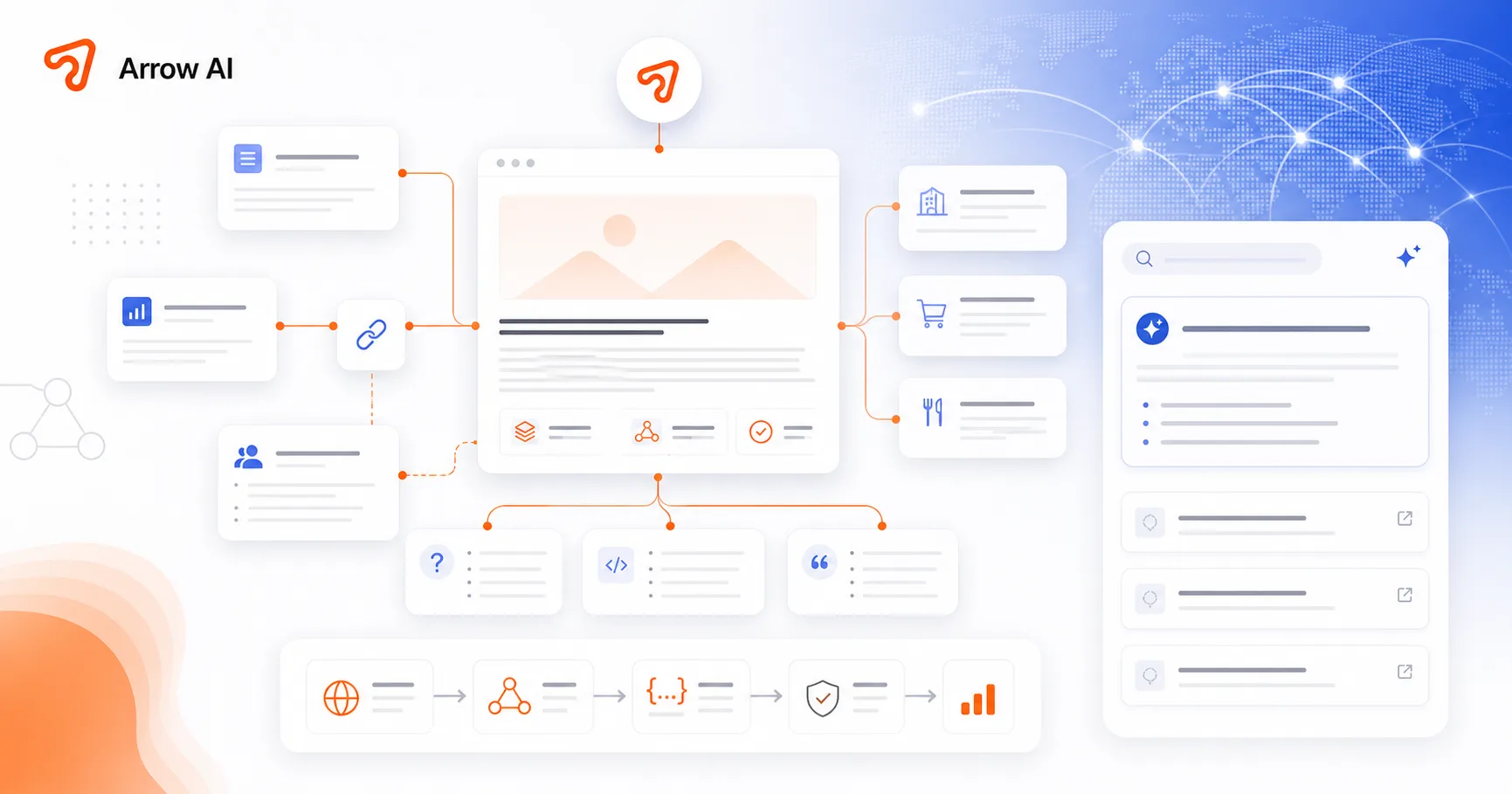
AI engines do not just crawl pages. They assemble answers.
A traditional blog can rank for keywords and still fail inside AI answers if the site does not explain the entity, the offer, the proof, the use case, and the next step clearly. GEO content hubs solve that by organizing pages around the questions buyers actually ask.
The goal is not to publish more for the sake of volume. The goal is to make every page useful, quotable, internally connected, and easy to verify.
The best GEO hubs connect five page types.
Start with the core service page, then surround it with industry pages, use-case pages, comparison or decision pages, proof pages, and FAQ pages. Each page should link back to the offer and forward to a clear conversion path.
For Arrow AI, that means pages around GEO visibility, custom AI systems, industries, case studies, and audit actions.
Every article should give AI systems clean signals.
Use descriptive titles, direct section headings, short definitions, structured metadata, schema, image alt text, breadcrumbs, canonical URLs, and internal links. These signals help search engines and AI systems interpret the page without guessing.
That does not mean writing robotic content. It means writing clearly enough that a person, a crawler, and an AI answer engine can all understand the same thing.
AI visibility improves when claims are easy to verify.
Publish public examples, case-study style explanations, service methodology, implementation steps, FAQs, constraints, and outcomes that are safe to share. Avoid private data, client secrets, internal prompts, or confidential dashboards.
Strong GEO content gives enough context to build trust without exposing anything sensitive.
Build a visible topical map.
Put it into practice
Reading is step one. The audit is step two.
See how AI engines describe your brand today — free, in two minutes.