 Arrow
Arrow 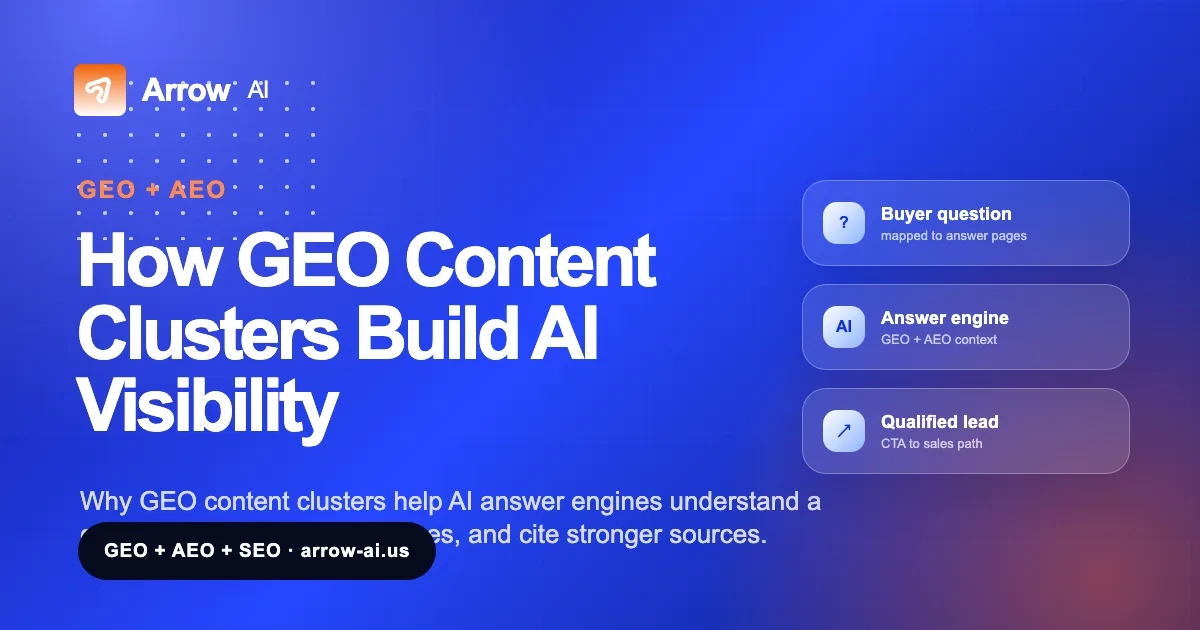
This guide explains the strategy, page structure, buyer intent, technical signals, and measurement layer behind practical GEO and AEO work. The goal is not to promise guaranteed AI rankings. The goal is to make how geo content clusters build ai visibility easier to understand, verify, cite, and act on.
Short answer
How GEO Content Clusters Build AI Visibility matters because buyers increasingly ask AI systems for recommendations, comparisons, risks, prices, providers, and next steps before they visit a website. GEO, AEO, and SEO help your company become clearer to humans and easier for answer engines to parse.
This guide explains the strategy, page structure, buyer intent, technical signals, and measurement layer behind practical GEO and AEO work. The goal is not to promise guaranteed AI rankings. The goal is to make how geo content clusters build ai visibility easier to understand, verify, cite, and act on.
Why the buyer journey changed
The buyer journey is no longer just a search result page. A user may ask ChatGPT for a shortlist, Perplexity for sources, Gemini for a comparison, or Google AI for a summary. If your pages do not explain the offer, proof, use cases, limitations, and next action, answer engines may rely on competitors or generic sources.
This guide explains the strategy, page structure, buyer intent, technical signals, and measurement layer behind practical GEO and AEO work. The goal is not to promise guaranteed AI rankings. The goal is to make how geo content clusters build ai visibility easier to understand, verify, cite, and act on.
What a strong page needs
A strong GEO page needs direct answers, entity clarity, useful examples, internal links, external references, FAQ structure, schema, and a clear CTA. A strong AEO section needs concise answers that can stand alone. A strong SEO foundation needs crawlable HTML, canonical URLs, metadata, and connected pages.
This guide explains the strategy, page structure, buyer intent, technical signals, and measurement layer behind practical GEO and AEO work. The goal is not to promise guaranteed AI rankings. The goal is to make how geo content clusters build ai visibility easier to understand, verify, cite, and act on.
What to avoid
Avoid fake claims, thin pages, keyword stuffing, copied competitor language, and promises that cannot be proven. GEO and AEO work best when the company is genuinely useful, specific, and consistent. This page intentionally avoids confidential tactics, private data, prompt maps, and client-specific operating details.
This guide explains the strategy, page structure, buyer intent, technical signals, and measurement layer behind practical GEO and AEO work. The goal is not to promise guaranteed AI rankings. The goal is to make how geo content clusters build ai visibility easier to understand, verify, cite, and act on.
How Arrow connects it
Arrow AI treats GEO and AEO as a visibility system: question research, answer pages, industry pages, structured data, internal links, tracking, reporting, and sales handoff. The public layer educates the market. The private operating layer helps teams execute with discipline.
This guide explains the strategy, page structure, buyer intent, technical signals, and measurement layer behind practical GEO and AEO work. The goal is not to promise guaranteed AI rankings. The goal is to make how geo content clusters build ai visibility easier to understand, verify, cite, and act on.
Internal and external references
Strong GEO and AEO work connects useful public pages to service pages, proof pages, and authoritative references. For Arrow, start with Arrow AI GEOGEO platformGEO vs SEOArrow Signalfree GEO auditcustom AI systemswhy AI answer visibility mattersbest GEO tools. For broader technical context, useful references include Google Search CentralGoogle SEO Starter GuideSchema.org FAQPageSchema.org ArticleOpenAI for businessPerplexityAnthropic Claude.