 Arrow
Arrow 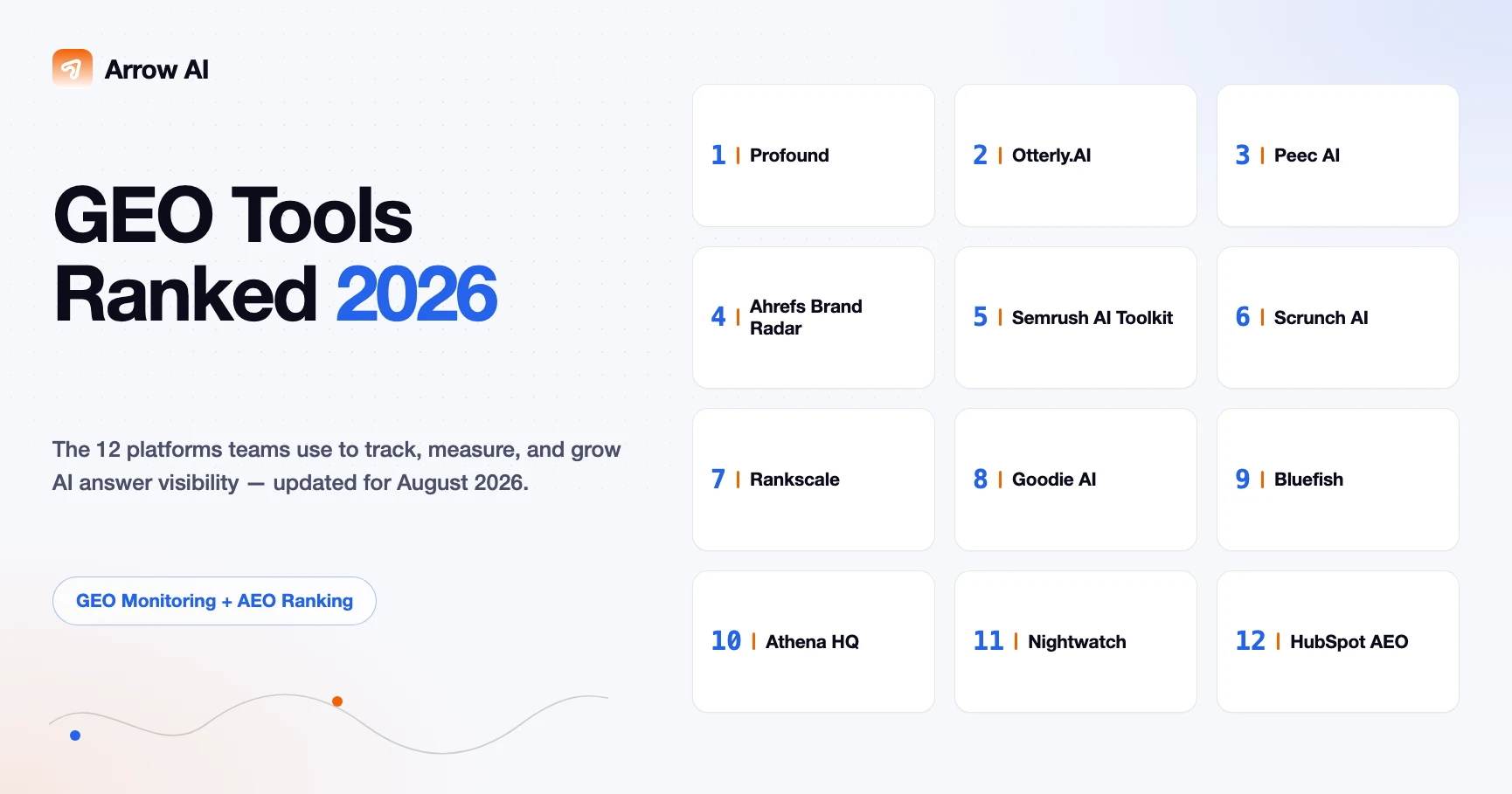
The best GEO tool in August 2026 depends on team size and budget. Profound is the deepest option for in-house teams that will act on the data. Otterly.AI and Peec AI are the easiest focused-monitoring starting points. Ahrefs Brand Radar and Semrush's AI Toolkit make sense as add-ons for teams already inside those suites. None of the twelve tools below rewrite your pages, fix your schema, or build your proof — that part is still a build, not a subscription.
GEO — generative engine optimization — is the work of getting a brand mentioned, cited, and recommended inside AI-generated answers from ChatGPT, Perplexity, Gemini, Google AI Overviews, Copilot, and Claude. A new category of software has grown up around it fast: tools that run daily prompts against these engines, log every citation, and tell a team whether it is winning or losing share of voice against competitors.
This ranking is a snapshot of where that market stands in August 2026. It leans on public comparisons, vendor pages, and category write-ups rather than paid trials of every tool, so treat the specifics — pricing, exact feature lists — as a starting point for your own evaluation, not a final word. What holds up across every source: this is a monitoring category first, and an execution category second. Most of these platforms are very good at telling you where you stand. Almost none of them touch the page.
The ranking: 12 GEO tools worth evaluating
These are ordered by how broadly they are recommended across the category in 2026, not by a paid or sponsored score. Several are close calls — the right one for your team depends on stack, budget, and whether you need monitoring only or monitoring plus content work.
Profound
Best for in-house teams that want the deepest analytics layer and will act on what it finds.
- The most cited platform in the category by review volume. Prompt-level citation tracking, competitor share of voice, and answer sentiment across the major engines, aimed at teams with a growth or content function to feed.
- Watch-out: analytics-heavy tools are only as useful as the team that turns the dashboard into page changes.
Otterly.AI
Best low-friction starting point for a small team or solo marketer testing the waters.
- Daily prompt tracking with brand mentions, citations, position, and sentiment across ChatGPT, AI Overviews, AI Mode, Perplexity, Gemini, and Copilot, priced as an accessible self-serve monthly plan.
- Watch-out: built for focused monitoring, not multi-brand agency reporting or content workflows.
Peec AI
Best for agencies and larger teams running AI visibility across several brands and countries.
- Well-funded category player built for multi-country reporting and unlimited seats, which is why it shows up repeatedly in agency comparisons.
- Watch-out: priced and packaged for teams managing several accounts, more than it needs to be for a single in-house brand.
Ahrefs Brand Radar
Best for teams already paying for Ahrefs and wanting AI visibility next to their existing backlink and keyword data.
- Ties GEO tracking to the SEO data Ahrefs already has on a domain, which lowers the setup cost for existing customers considerably.
- Watch-out: strongest when the team is already living inside Ahrefs day to day, less compelling as a standalone purchase.
Semrush AI Toolkit
Best for teams standardized on Semrush who want AI visibility benchmarking without adding a new vendor.
- Adds AI visibility benchmarking, brand sentiment, prompt discovery, and competitor gap analysis on top of an existing Semrush plan.
- Watch-out: an add-on, not a standalone product — you are paying for the base Semrush suite either way.
Scrunch AI
Best for enterprise teams that want the tool to also fix how AI crawlers read pages they already own.
- Goes further than most competitors by touching onsite optimization directly, not just reporting the citation gap from the outside.
- Watch-out: enterprise-leaning and typically quote-based, so it is a heavier commitment than a self-serve monitoring tool.
Rankscale
Best for teams that want broad engine and country coverage without per-engine surcharges.
- Positioned around wide tracking across many AI engines and regions at a lower entry price than several category peers.
- Watch-out: breadth of coverage is not the same as depth of analysis — check reporting detail against your actual needs.
Goodie AI
Best for teams that want visibility tracking paired with content generation in one place.
- An all-in-one AEO tool that tries to close the gap between finding a citation problem and drafting content to fix it.
- Watch-out: generated drafts still need a human editorial and fact-check pass before they go anywhere public.
Bluefish
Best for consumer and DTC brands tracking whether AI assistants recommend them by name.
- Focused specifically on brand discovery and recommendation monitoring — the "would an AI suggest us" question rather than broad citation counting.
- Watch-out: narrower scope than full-suite competitors, which is a feature if that is the exact question you have.
Athena HQ
Best for a clean, straightforward read on brand presence across AI-generated answers.
- Tracks brand presence and performance across AI answers without the added complexity of onsite fixes or content tooling.
- Watch-out: newer entrant in the category — check current feature depth against the more established players above.
Nightwatch
Best for teams that don't want a separate tool just for AI citations on top of SEO rank tracking.
- Combines traditional SERP rank tracking with AI visibility monitoring in a single dashboard, which suits teams that would rather not run two tools.
- Watch-out: a generalist tool covering two jobs — compare its GEO depth against category specialists before committing.
HubSpot AEO
Best free first look for teams already running HubSpot's CRM and marketing tools.
- A free AI-readiness grader covering structured data, FAQ schema, and E-E-A-T signals, with expanded paid tracking for teams that want more.
- Watch-out: the free grader is a snapshot, not ongoing daily monitoring — treat it as a starting point, not a substitute for tracking.
Scorecard: what each tool is actually for
| Tool | Best use | Category | Where it stops |
|---|---|---|---|
| Profound | Deep analytics for in-house teams | Monitoring | Needs a team to act on findings |
| Otterly.AI | Simple daily monitoring, low cost | Monitoring | Not built for agency scale |
| Peec AI | Multi-brand, multi-country reporting | Monitoring | Priced for agencies, not solo brands |
| Ahrefs Brand Radar | AI visibility next to SEO data | Monitoring add-on | Best inside the Ahrefs ecosystem |
| Semrush AI Toolkit | AI visibility next to SEO data | Monitoring add-on | Requires an existing Semrush plan |
| Scrunch AI | Monitoring plus onsite fixes | Monitoring + execution | Enterprise pricing and scope |
| Rankscale | Broad engine and country coverage | Monitoring | Depth varies by report |
| Goodie AI | Monitoring plus content drafts | Monitoring + content | Drafts still need human review |
| Bluefish | Brand recommendation tracking | Monitoring | Narrower scope by design |
| Athena HQ | Straightforward presence tracking | Monitoring | Newer, smaller feature set |
| Nightwatch | SEO rank tracking plus AI visibility | Monitoring | Generalist, not a GEO specialist |
| HubSpot AEO | Free readiness check for HubSpot users | Free grader | Snapshot, not ongoing tracking |
The gap every one of these tools leaves
Read through enough GEO tool comparisons and a pattern shows up: the entire category is built to answer one question — where do we stand right now? Citation counts, share of voice, sentiment, competitor comparisons. That is genuinely useful. A team that has never measured AI visibility should start there, not skip it.
But a dashboard is a thermometer, not a cure. Almost none of these tools rewrite your pages, restructure your schema, build the comparison and FAQ content that AI engines actually retrieve, or earn the external mentions that make your claims verifiable. Scrunch AI and Goodie AI push furthest into that territory — onsite fixes and content drafts respectively — and even there, a human still owns the judgment calls: what to say, what to prove, and what to link.
What Arrow does with the findings
Run one of the tools above, or Arrow's own free audit, and you'll get a list of gaps: missing schema, thin comparison pages, weak proof, no FAQ coverage for the questions buyers actually ask AI. Arrow's GEO work starts where the dashboard stops — building the pages, structured data, and internal links that turn a citation gap into a citation.
See Arrow GEOHow to actually pick one
Start free or cheap. HubSpot's grader or Otterly.AI's entry plan will tell you in a day whether you have a visibility problem worth solving. If the answer is yes and you already pay for Ahrefs or Semrush, turn on their AI add-on before buying a new vendor — it is the lowest-friction way to get ongoing tracking.
Move up to Profound, Peec AI, or Rankscale once you need real reporting depth, multiple brands, or broader engine and country coverage. Consider Scrunch AI or Goodie AI specifically when you want the tool to help close the gap, not just measure it — and budget for the fact that either way, someone still has to write, structure, and publish the fix.
Whatever you pick, re-run the same prompts monthly and track the trend, not a single snapshot. AI engines update their retrieval and ranking behavior constantly; a good score in August tells you little about October unless you keep watching.
Arrow AI
Want your GEO gap mapped and closed?
Run the free audit. Arrow looks at how AI engines currently describe your company, where competitors are winning citations instead, and what pages, schema, and proof would close the gap — then builds it.