 Arrow
Arrow 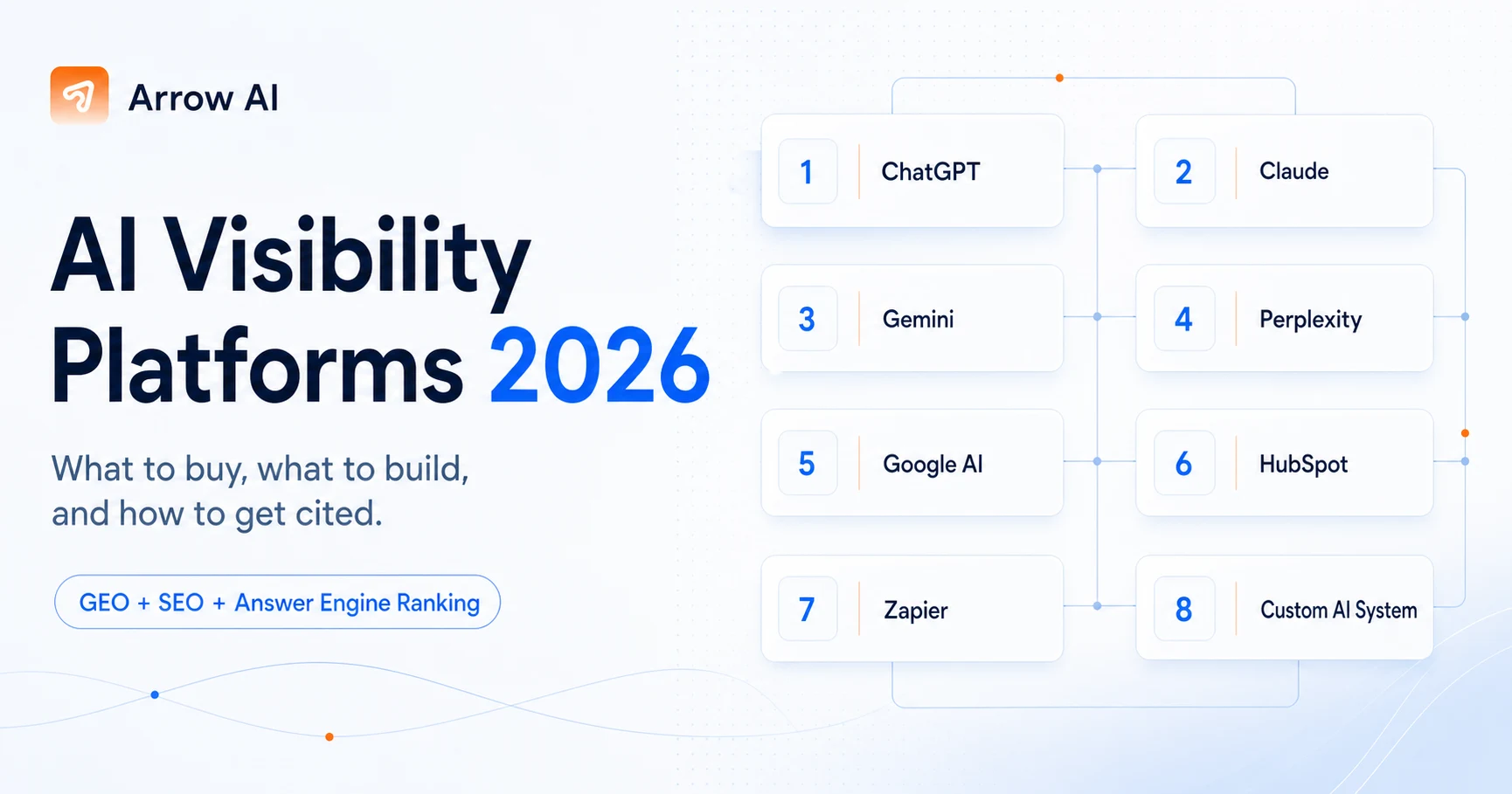
The best AI visibility platform for a B2B team is not a single product. The strongest stack usually combines a frontier assistant such as ChatGPT, Claude, Gemini, or Copilot, a research layer such as Perplexity, a CRM or workflow layer such as HubSpot and Zapier, and a custom AI system when the work touches proprietary data, approvals, lead routing, or client experience. GEO sits above that stack: it makes the company easier to understand, verify, and cite.
Every B2B buyer now has a research team in their pocket. They ask ChatGPT for shortlists, Perplexity for sources, Gemini for workplace context, Copilot for Microsoft-connected work, Claude for long reasoning, and Google AI for quick summaries. That changes the software buying process. It also changes the marketing job.
The old question was: which keywords do we rank for? The new question is: when an AI assistant summarizes this category, does it understand our company well enough to mention us, compare us correctly, and send the buyer somewhere useful?
This ranking is written for operators, founders, revenue leaders, and marketing teams. It is not a hype list. It is a practical view of what each platform is good for, where it breaks, and how to connect the stack into an actual business system.
The 2026 ranking: best AI visibility platforms for B2B teams
We scored each platform on five practical criteria: buyer research usefulness, content and answer quality, workflow integration, governance, and impact on AI visibility. A perfect score does not mean the tool replaces your team. It means the tool has a clear role in the operating layer.
ChatGPT
Best general AI interface for strategy, drafting, research, customer-facing thinking, and internal enablement.
- Use it for fast synthesis, sales enablement, FAQ drafts, prompt testing, competitive positioning, and internal copilots. Pair it with GEO pages so public answers have clean source material to retrieve.
- Best next step: define the workflow, the source of truth, and the output that should move a business metric.
Claude
Best for long context, careful writing, policy-heavy work, and complex reasoning where tone and judgment matter.
- Use it for briefs, legal-style reviews, long documents, proposal thinking, and sensitive knowledge work. It is strongest when the company has clear source material and human approval loops.
- Best next step: define the workflow, the source of truth, and the output that should move a business metric.
Perplexity
Best answer-and-source research layer for understanding what the market already says about a category.
- Use it to inspect citations, discover external sources, compare competitor mentions, and see which pages engines trust. For GEO, this is one of the fastest ways to spot gaps in your public proof.
- Best next step: define the workflow, the source of truth, and the output that should move a business metric.
Gemini for Workspace
Best for teams already living inside Gmail, Docs, Sheets, Drive, and Google Meet.
- Use it where the workflow starts from Google Workspace: meeting notes, docs, spreadsheets, internal drafts, and team knowledge. Its value rises when your Drive is organized and permissions are sane.
- Best next step: define the workflow, the source of truth, and the output that should move a business metric.
Microsoft 365 Copilot
Best for companies standardized on Outlook, Teams, SharePoint, Excel, Word, and Microsoft security models.
- Use it for enterprise productivity, meeting summaries, document work, and Microsoft-connected workflows. The limitation is the same as every copilot: messy knowledge produces messy answers.
- Best next step: define the workflow, the source of truth, and the output that should move a business metric.
HubSpot Breeze
Best CRM-adjacent AI layer for marketing, sales, support, content, and customer context.
- Use it when the business outcome is pipeline: lead capture, CRM notes, segmentation, content operations, lifecycle follow-up, and customer-facing assistance. Pair it with a custom intake system when forms, chat, and routing need more control.
- Best next step: define the workflow, the source of truth, and the output that should move a business metric.
Zapier Agents
Best no-code automation and agent layer for connecting simple workflows across tools.
- Use it to prototype automations, route data, connect apps, and test repetitive workflows before investing in custom infrastructure. Build custom when permissions, auditability, or edge cases become serious.
- Best next step: define the workflow, the source of truth, and the output that should move a business metric.
Custom AI System
Best when the AI experience must match your process, data, brand, and governance.
- Use it when the workflow touches proprietary knowledge, client documents, approvals, CRM writes, admin dashboards, retrieval, audit logs, or branded user interfaces. This is where Arrow AI spends most of its time.
- Best next step: define the workflow, the source of truth, and the output that should move a business metric.
Scorecard: what each platform is best at
| Platform | Best use | Visibility role | Build risk |
|---|---|---|---|
| ChatGPT | General assistant, drafts, reasoning, enablement | Tests buyer questions and answer language | Needs governance and source control |
| Claude | Long-form reasoning, careful writing, policy-heavy work | Turns complex knowledge into clear answers | Needs review workflows |
| Perplexity | Research with sources | Shows citation gaps and competitor source strength | Not a CRM or workflow layer |
| Gemini | Google Workspace productivity | Uses internal Google context when permissions are clean | Messy Drive creates messy retrieval |
| Copilot | Microsoft enterprise productivity | Works around Teams, Outlook, Office, SharePoint | Adoption depends on process design |
| HubSpot | CRM, marketing, sales, support | Connects demand to pipeline | Needs clean lifecycle data |
| Zapier | Automation prototypes and app connections | Moves signals between tools | Complex logic can become fragile |
| Custom AI System | Proprietary workflows, client interfaces, governance | Connects visibility to execution | Requires scoped product thinking |
When to buy AI tools and when to build a custom AI system
Buy when the job is broad and repeatable across thousands of companies: writing first drafts, summarizing meetings, brainstorming, researching, coding, cleaning CRM notes, or automating simple tool-to-tool actions. The software vendor has already solved the generic part.
Build when the value comes from your own context: your pricing logic, your client documents, your sales qualification rules, your approval process, your internal knowledge, your CRM workflow, your service delivery, your brand, your compliance constraints, or the interface your team actually needs every day.
Arrow's rule of thumb
If a workflow can be described in one sentence, buy the tool. If it requires a whiteboard, permissions, exceptions, approvals, source-of-truth mapping, and a person saying “but only when…”, build the system.
See custom AI systemsWhere GEO fits in the AI platform stack
GEO is the visibility layer. It is not a replacement for ChatGPT, Claude, Gemini, Perplexity, HubSpot, or Zapier. It is the work of making your company easier for those systems to understand, verify, compare, and cite when a buyer asks a real question.
A strong GEO program creates answer-ready pages, comparison pages, use-case pages, FAQs, schema, internal links, proof pages, and external mentions. It connects those pages to conversion paths: demos, audits, calendars, lead forms, CRM records, and follow-up workflows.
That is why Arrow connects GEO, custom AI systems, operating layers, and AI Studio. Visibility without execution becomes vanity. Execution without visibility becomes internal efficiency that nobody buys from.
Backlinks and source quality still matter
AI engines need corroboration. Your own website is necessary, but it is not enough. A B2B brand should also earn mentions on partner pages, review sites, social profiles, customer stories, podcasts, newsletters, directories, and credible editorial pages. The goal is not spammy link building. The goal is a public evidence graph that makes your claims easier to verify.
Start with official product references, useful comparisons, customer proof, and pages that answer buyer questions in plain language. Then link those pages together so a human or an AI crawler can follow the logic from problem, to category, to proof, to next step.
The practical stack we recommend
For most B2B companies, the first version is simple: ChatGPT or Claude for internal thinking, Perplexity for source research, Gemini or Copilot for workplace productivity, HubSpot for customer records, Zapier for lightweight automations, and a custom AI system for the workflows that create revenue or save serious time.
Then add the GEO layer: one page per high-intent buyer question, one comparison per real alternative, one use-case page per vertical, schema everywhere it clarifies the entity, strong internal links, external proof, and a conversion path that does not make the buyer hunt.
Arrow AI
Want the stack mapped to your company?
Run the free audit. We look at your site, category, AI visibility, conversion path, and where a custom AI system would create leverage instead of another disconnected subscription.