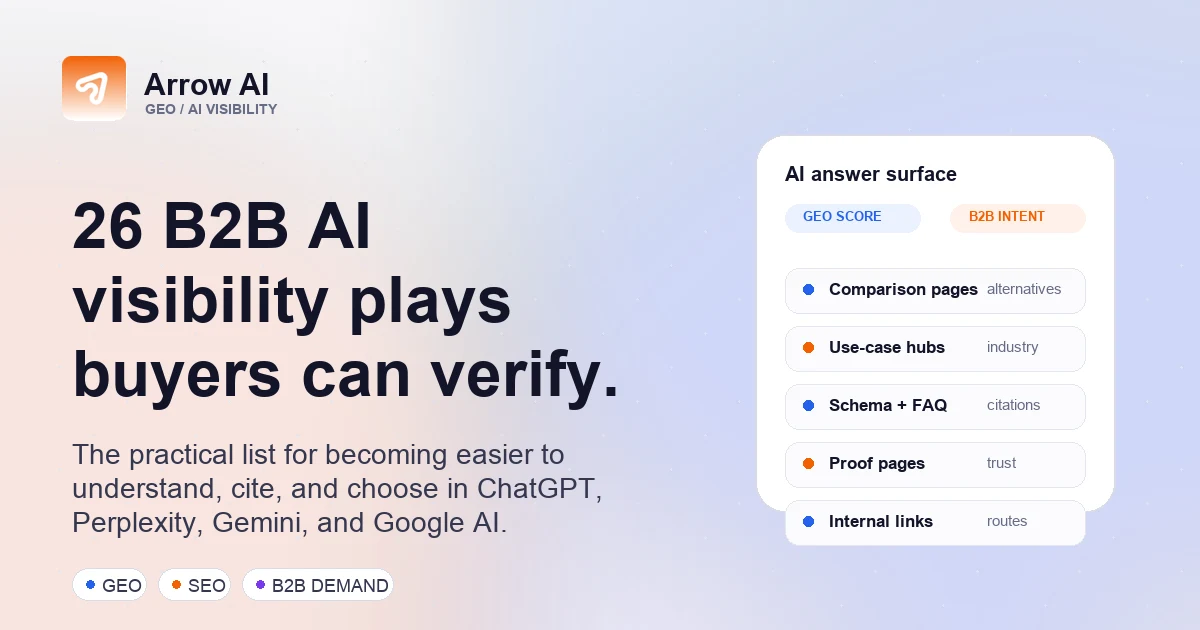
Short answerThe best B2B AI visibility strategy is not one page or one prompt. It is a connected system of answer-ready pages, comparison pages, proof, schema, internal links, credible external mentions, and conversion paths that helps AI engines verify your company.
Why B2B AI visibility is now buyer-intent infrastructure
B2B buyers increasingly ask answer engines to shortlist vendors, compare alternatives, explain implementation risk, summarize pricing, and recommend the next step. If your company is not legible across those questions, the AI can still answer - it will just answer with a competitor, a directory, or a generic summary.
That is why Arrow AI treats GEO as infrastructure. The goal is to make your entity, offer, proof, use cases, integrations, and limits easy to parse for humans, crawlers, and AI systems. This connects to Arrow GEO, the AI visibility platform page, and your conversion layer: audit, demo, chat, CRM, and follow-up.
The 26 best B2B AI visibility plays
1. Define the entityMake the company name, category, market, offer, and geography explicit.2. Create problem pagesAnswer the pain buyers describe before they know your product.3. Create use-case pagesMap the offer to real operating situations and measurable outcomes.4. Create comparison pagesExplain differences against alternatives without hype.5. Create alternatives pagesShow when you are a fit and when another tool may be better.6. Publish pricing contextEven ranges, setup logic, and scope drivers reduce uncertainty.7. Build industry pagesConnect the system to legal, healthcare, real estate, ecommerce, or service workflows.8. Add integration pagesAnswer whether you connect with CRM, docs, calendar, email, analytics, and data tools.9. Write proof pagesShow outcomes, timelines, constraints, and before/after details.10. Add FAQ schemaMake question-and-answer blocks visible and machine-readable.11. Use descriptive alt textDescribe images with the topic, brand, and use case.12. Use internal linksRoute every topic page toward related service, proof, and CTA pages.13. Add breadcrumbsClarify page hierarchy for search and answer engines.14. Keep pages freshUpdate dates, examples, screenshots, and data when the market changes.15. Cite credible sourcesLink to standards, documentation, official docs, and neutral references where useful.16. Earn external mentionsBacklinks from relevant partners, directories, articles, and profiles support trust.17. Create answer summariesOpen sections with direct answers that AI can quote.18. Build topical clustersOne hub page plus specific supporting pages beats scattered posts.19. Expose limitationsTrust improves when the page explains constraints and edge cases.20. Add author and publisher dataUse Organization and BlogPosting schema consistently.21. Track prompt visibilityMonitor buyer questions, competitor mentions, and citation presence.22. Measure lead pathsConnect visibility to forms, calendar bookings, CRM records, and follow-up.23. Create demo-intent pagesAnswer how implementation works before sales calls.24. Make social profiles consistentLinkedIn, YouTube, Instagram, and directories should repeat the same entity facts.25. Use clean HTMLHeadings, sections, lists, and tables should be easy to crawl.26. Build a real systemGEO works when content, schema, links, proof, and sales workflow reinforce each other. Backlinks and references that actually help
For B2B GEO, "backlinks" should mean credible context, not spam. Useful sources include partner pages, customer stories, integration directories, founder profiles, industry publications, event pages, and resource lists that describe what the company actually does.
Internally, every new page should also link back to a core page. For this article, the core pages are AI Visibility Platform, GEO, Get Found in AI, GEO Platform, Custom AI Systems, and the free audit.
The Arrow read
GEO is strongest when it becomes a sales system.
Ranking is only the first layer. The business value appears when AI-visible pages route buyers toward forms, calendar links, CRM workflows, proof, and human follow-up. That is why Arrow connects GEO with custom AI systems.
 Arrow
Arrow