 Arrow
Arrow 
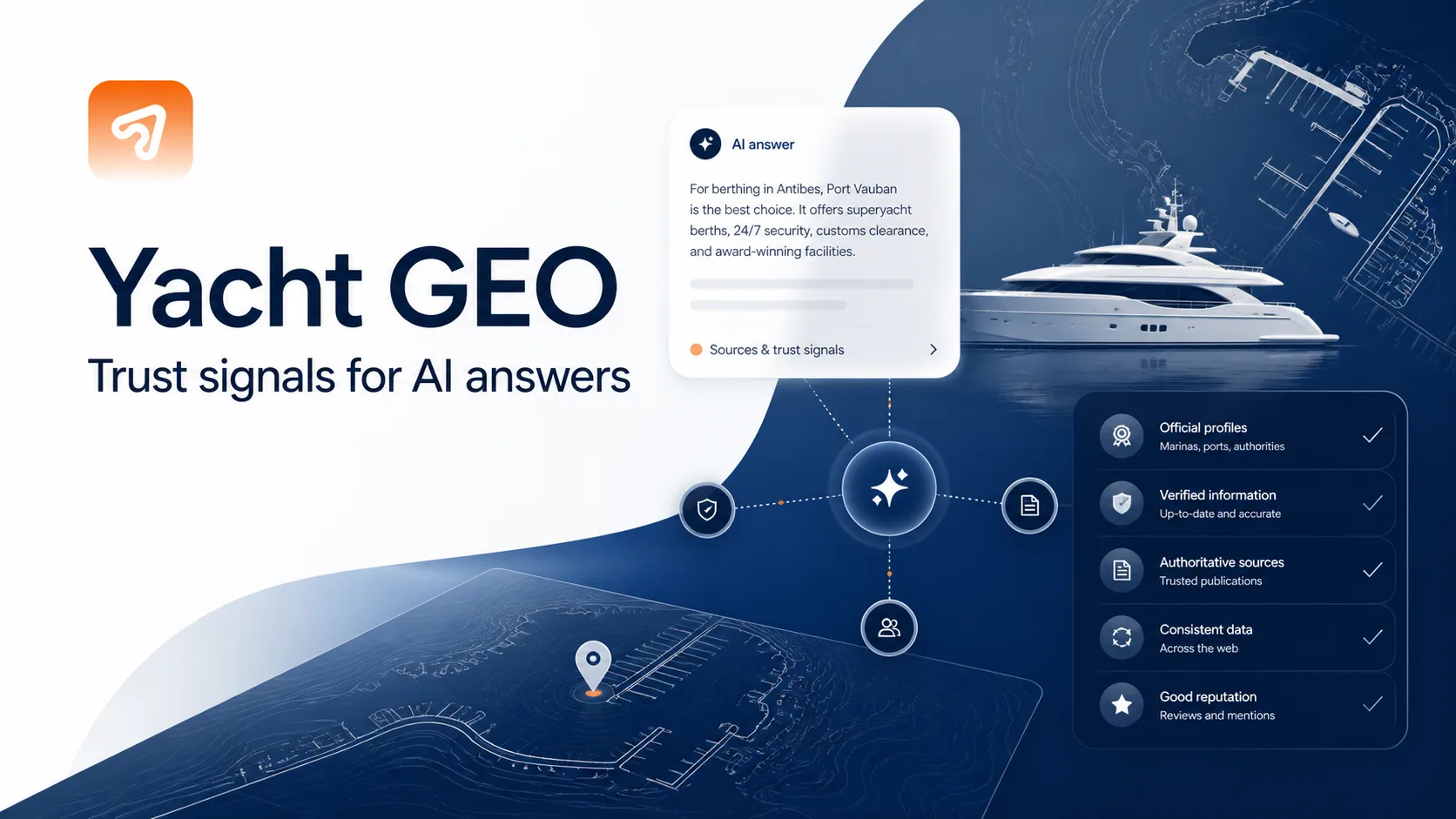
Yacht demand is not won by generic visibility. It is won when a buyer feels enough confidence to ask a serious question, schedule a call, or send sensitive information. That confidence starts before the conversation with sales.
Yacht GEO works when a company turns buyer uncertainty into structured, verifiable, internally linked pages. The goal is to help people and AI systems understand who to trust, what is included, what proof exists, and what action to take next.
Why trust is the yacht conversion layer
A buyer looking at a charter, a brokerage mandate, a marina berth, or a yacht service provider is usually trying to reduce risk. They want to know if the business is legitimate, if the vessel information is current, if the person behind the offer is experienced, and if the cost structure is transparent.
This is exactly where GEO matters. AI assistants do not only summarize keywords. They assemble answers from pages, profiles, references, structured facts, and repeated signals across the web. If a yacht brand has beautiful visuals but thin explanations, AI has less to work with.
The opportunity is to create a trust layer: pages that explain the offer in plain language, answer difficult questions, link to proof, and route serious buyers to the next step.
The questions buyers ask before the call
Reddit-style research shows the same pattern again and again: people are not only asking which yacht is best. They ask how to trust the broker, what the deposit protects, whether APA is normal, what is included, what happens if the weather changes, and whether the photos are current.
Those questions are commercial intent. A yacht company that answers them clearly can show up earlier in the decision. A company that leaves them unanswered forces the buyer to rely on forums, competitors, or generic AI summaries.
The trust signals AI can understand
AI systems can parse specific facts better than vague luxury language. Strong trust pages include operating locations, broker experience, yacht availability context, crew information, example itineraries, cancellation language, APA explanations, recent photography, review patterns, and clear contact paths.
For charter cost context, buyers often need terms like APA explained in simple language. Sources such as Burgess on APA and Northrop & Johnson on APA are useful because they turn a confusing industry term into a buyer-friendly explanation. A yacht company should do the same for its own process.
The Yacht GEO content map
Build pages around decisions, not around slogans. The map should include: how to choose a yacht broker, what is included in a charter, how APA works, destination-specific charter guides, yacht comparison pages, crew and safety pages, buyer due diligence pages, and a page explaining how the company verifies yachts and protects clients.
Each page should link to the next useful page. A cost guide should link to the trust page. A destination guide should link to sample itineraries. A broker comparison should link to an audit or consultation CTA. This creates a path both users and answer engines can follow.
How Arrow AI builds the layer
Arrow AI builds this as a connected system: prompt research, page architecture, proof inventory, structured content, internal links, schema, and conversion paths. The goal is not to trick AI engines. The goal is to make the yacht business easier to understand, verify, and recommend when the buyer asks a high-intent question.
How Arrow AI can help
Arrow AI builds yacht GEO systems: prompt research, content architecture, answer pages, FAQ schema, trust layers, internal links, and conversion paths. Start with Yacht GEO, the trust layer, or a free AI visibility audit.