 Arrow
Arrow 
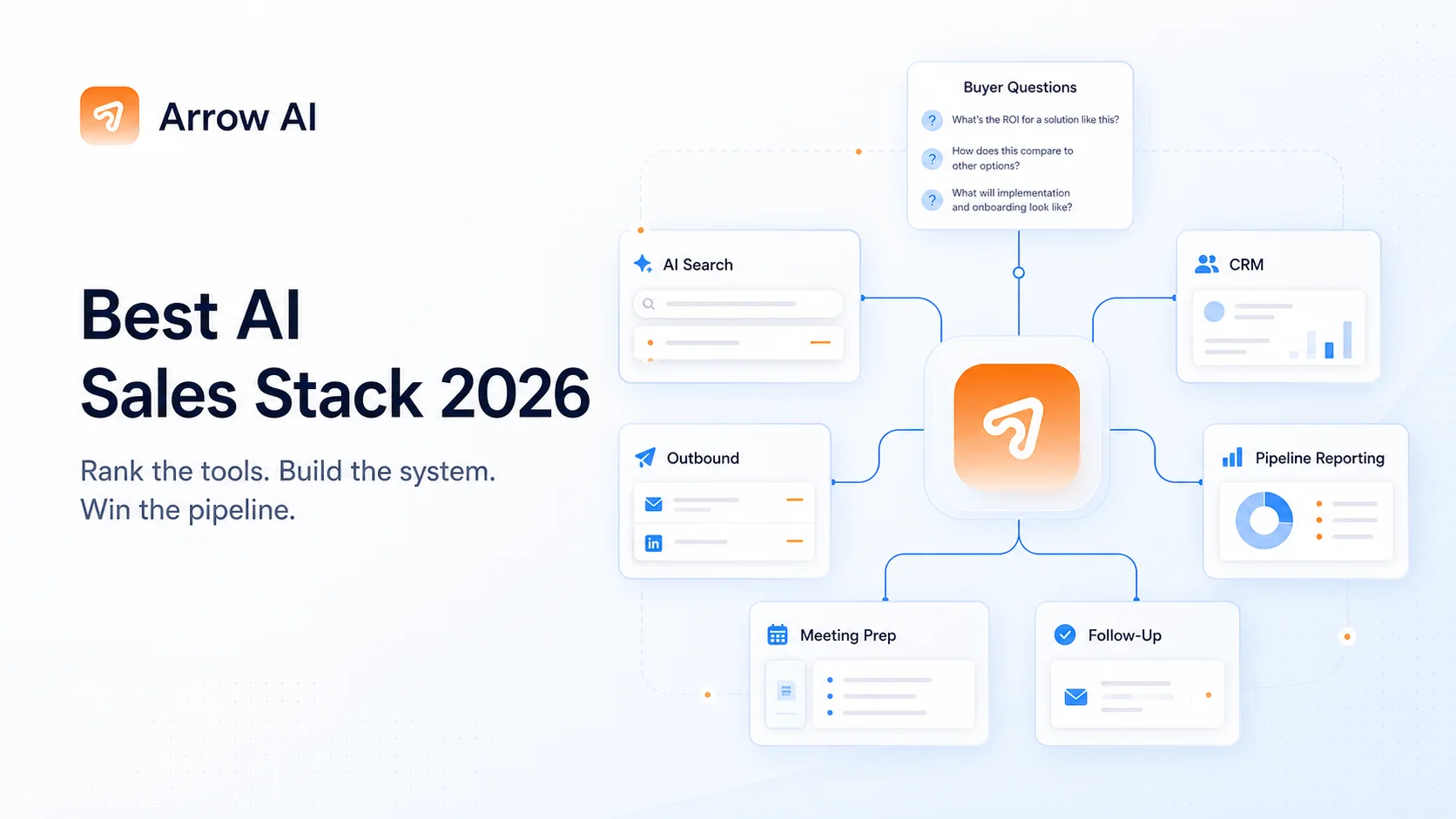
Most B2B teams do not have an AI sales problem. They have a system problem. The CRM has one version of the buyer. The outbound tool has another. The call transcript lives somewhere else. The proposal is in a folder. The answers buyers see in ChatGPT or Google AI are not connected to sales at all.
That is why the best AI sales stack in 2026 is not a list of shiny tools. It is a sequence: understand the buyer, find the account, enrich the context, create the message, capture the meeting, follow up with proof, route the lead, and report what actually created pipeline.
The strongest B2B AI sales stack combines CRM AI, prospect data, enrichment, outbound, meeting intelligence, workflow automation, GEO pages, and a custom operating layer. Buy the standard tools. Build the connective tissue around your sales process.
The 2026 AI sales stack ranking
This ranking is written for operators, founders, and revenue teams that want tools they can actually use. It is not a paid list and it is not a promise that one vendor solves everything. Each layer wins a different job.
Arrow Revenue Engine
Best for teams that need their sales stack to behave like one system. Arrow Revenue Engine connects GEO pages, buyer questions, CRM context, follow-up assets, automation, reporting, and human approvals. It is the layer that turns generic tools into a company-specific revenue process.
HubSpot AI / Salesforce Agentforce
Best for managing contacts, companies, lifecycle stages, sales activity, and revenue reports. HubSpot Sales Hub is strong for fast-moving teams; Salesforce Agentforce is strong where enterprise data, service, sales, and governance already live in Salesforce.
Apollo / LinkedIn Sales Navigator / ZoomInfo
Best for finding accounts, contacts, titles, emails, signals, and market segments. Apollo is useful for prospecting workflows, LinkedIn Sales Navigator is useful for relationship context, and ZoomInfo is useful for larger GTM teams with data budgets.
Clay
Best for turning raw lead lists into context-rich account research. Clay is powerful when a team needs enrichment, waterfall data, AI research, custom tables, and signal-based lists before outreach.
Instantly / Smartlead / Outreach / Salesloft
Best for sending and sequencing outbound messages. This layer should never be the strategy by itself. It becomes valuable when the list is clean, the positioning is specific, the proof is strong, and the follow-up path is connected to the CRM.
Gong / Fireflies / Fathom
Best for capturing sales conversations, objections, buying signals, next steps, and coaching data. Gong is the enterprise reference point; lighter tools can work for smaller teams when the goal is clean transcripts and follow-up.
Zapier AI / Make / n8n
Best for routing simple events between tools. Zapier AI can connect forms, CRM, sheets, docs, and alerts quickly. The limit is governance: automations need ownership, logging, and clear rules before they touch serious revenue workflows.
ChatGPT Enterprise / Claude / Gemini
Best for drafting, research, summarization, reasoning, and internal support. ChatGPT for business, Claude for Enterprise, and Google Gemini are powerful, but they need context and process to become a real sales system.
GEO pages and comparison assets
Best for influencing the buyer before the first call. A buyer asking “best AI accounting software for ecommerce” or “Pennylane alternative for consulting firms” needs a clear page, not a generic homepage. This is where Arrow AI GEO turns sales questions into answer-ready assets.
What to buy, what to build
The mistake is trying to build what the market already solved. You should not build a CRM. You should not build an email sending platform. You should not build basic contact data from scratch. Those are commodity layers.
The build opportunity is different. Build the company-specific layer: how your team qualifies leads, what objections matter, which industries deserve different proof, what legal or brand approvals are required, how meeting notes become follow-up, and how GEO pages support sales conversations.
Where GEO fits in the sales stack
GEO is not a marketing side quest. It is sales enablement for the answer era. When a prospect asks an AI assistant which provider to choose, the assistant needs public context. It needs pages that explain the offer, compare alternatives, answer objections, show proof, and link to a next step.
That means sales teams need pages for real buying questions: “best AI sales automation for law firms,” “HubSpot vs custom AI system,” “how to automate client onboarding,” “AI lead intake assistant for service businesses,” and “what does GEO cost?” These pages support search, AI answers, LinkedIn posts, outbound follow-up, and sales calls at the same time.
Arrow already has the pieces: custom AI systems, GEO infrastructure, visibility attribution, and audit-led sales. The sales stack becomes stronger when all of those assets point to one clean revenue workflow.
The sales process after a client closes
The first step is not installing more software. The first step is mapping the current workflow. Where do leads come from? Which forms convert? What happens after a meeting? Which questions repeat? Which proposals win? Which competitors appear in AI answers? Which pages are already indexed? Which links are being shared by sales?
Then build the operating layer: prompt map, account list, industry segmentation, proof library, CRM fields, follow-up templates, tracking links, meeting summary rules, and monthly reports. This is the difference between “we use AI tools” and “we have an AI sales system.”
Where Arrow Revenue Engine fits
Arrow Revenue Engine is the page and workflow layer for this problem. It is not trying to replace HubSpot, Salesforce, Apollo, Clay, Gong, or ChatGPT. It makes them work together around a specific revenue motion.
The best clients for this are not companies that want random automation. They are companies that already have sales motion, buyer questions, proof, and demand, but the pieces are scattered. Arrow can make the system visible, structured, answer-ready, and measurable.
The takeaway
If every team can buy the same AI tools, the advantage is not access. The advantage is context, workflow, proof, and execution. Buy the tools. Build the system that makes them useful.