 Arrow
Arrow 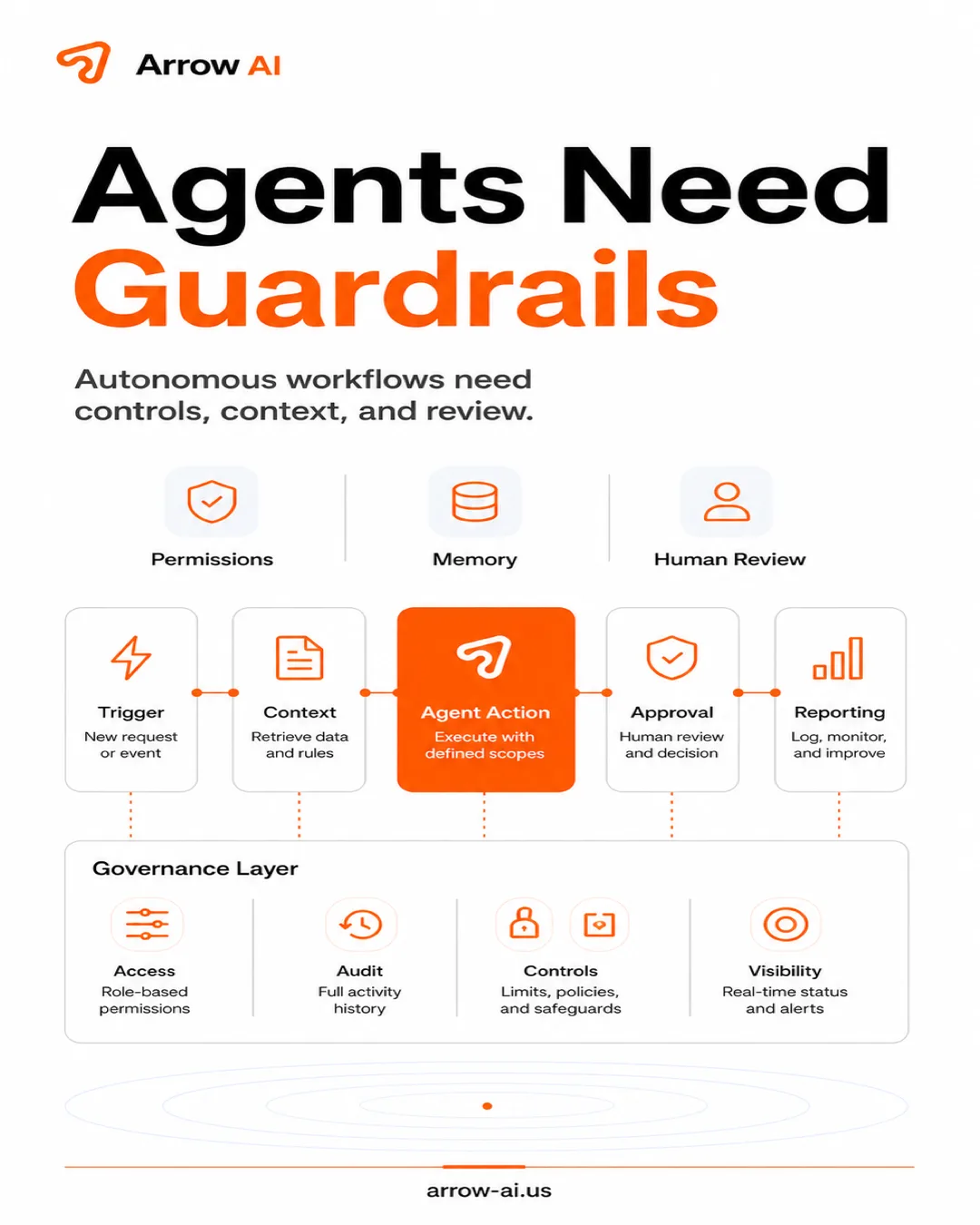
Most companies ask the wrong first question. They ask, “How autonomous can this agent be?” The better question is, “What is the safest repeatable workflow this agent can improve?” Guardrails are not a limitation. They are what make AI agents deployable.
An agent without rules is just a fast employee with no manager.
AI agents can retrieve information, draft messages, update systems, summarize calls, qualify leads, create documents, and route tasks. But every one of those actions touches business context. If the source is wrong, the permission is unclear, or the escalation path is missing, the output becomes hard to trust.
That is why Arrow AI builds agents inside custom AI systems. The model is one part of the architecture. The real value comes from the surrounding layer: data access, workflow logic, approvals, analytics, and human review where it matters.
The five controls every business AI agent needs.
Approved knowledge
The agent should answer from verified sources: docs, CRM records, product data, policies, FAQs, and service pages.
Permission levels
Not every agent should see every field, contact, document, or internal note. Role-based access matters.
Action boundaries
Define what the agent can draft, suggest, update, send, or never touch without human validation.
Escalation rules
When confidence is low or risk is high, the agent should route the task to a person instead of improvising.
Logs and visibility
Teams need to see what was asked, what source was used, what action happened, and what changed.
Feedback loops
Corrections should improve the knowledge base, prompts, routing rules, and operating process over time.
We make agents operational, not theatrical.
A demo agent can impress a room. An operational agent has to survive messy inputs, real customers, incomplete data, and team adoption. Arrow AI designs the interface, workflow, governance, and integrations around the business process first.
For more context, read why custom AI systems beat generic tools and how the AI operating layer connects tools, data, agents, and decisions.
Put it into practice
Reading is step one. The audit is step two.
See how AI engines describe your brand today — free, in two minutes.