 Arrow
Arrow 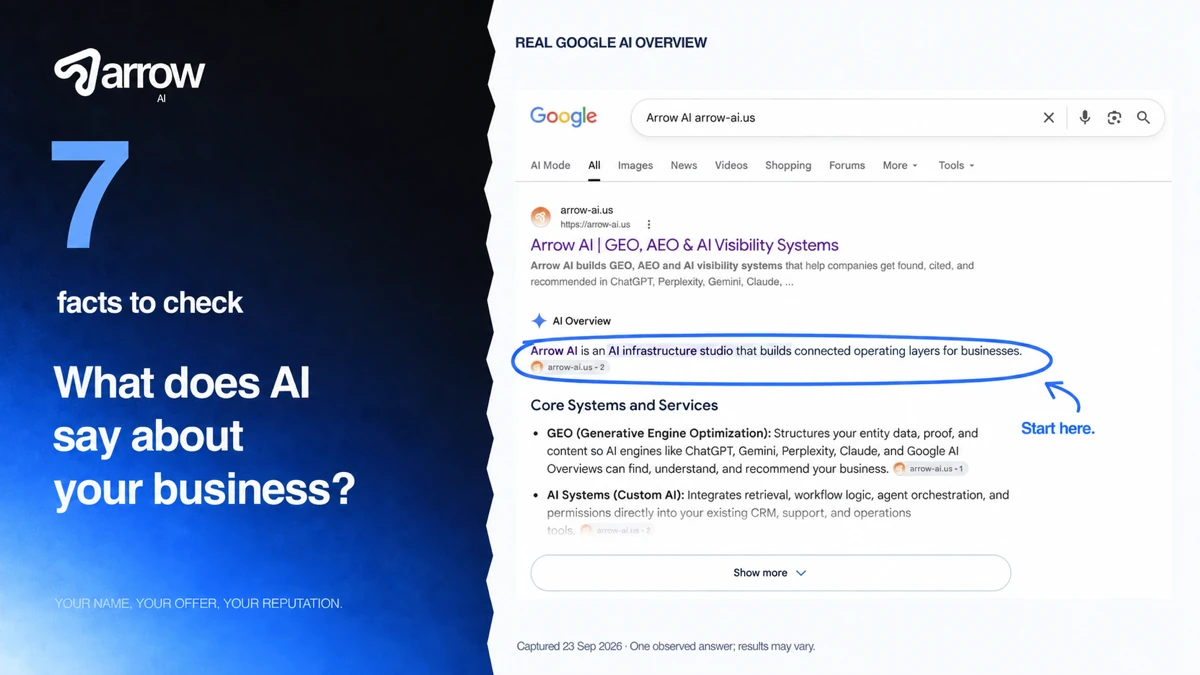
Check how AI describes your business with a seven-fact audit: identity, services, audience, location, pricing, conditions and evidence.
- 1. Observe the answer
- 2. Verify the fact
- 3. Correct the source
- 4. Recheck the answer
Your business can appear and still be described incorrectly.
Being named in an AI answer is only the beginning. A useful answer must identify the right business, describe the current offer and give the customer a sensible next step. A restaurant mentioned for private dining gains little from a description that doubles its room capacity. A software company can receive the wrong enquiries if a summary says an enterprise feature is available on its entry plan.
Start with accuracy before treating mentions as success. The practical question is: could someone make the wrong decision after reading this answer? That question works for a shop owner, a marketing team and a company with several locations. You do not need a large monitoring programme to find the first material error.
This guide gives you an initial review you can perform with a spreadsheet and your approved business information. It is a diagnostic exercise, not a market-wide visibility study. Use the specialist guides linked below when an individual problem needs deeper investigation.
Which seven business facts should you check?
Check identity, offer, audience, geography, price, operating conditions and evidence. Those seven categories connect a business description to the decisions people actually make. A flattering description with an incorrect price deserves more attention than an awkward adjective with no practical consequence.
| Fact | Question to ask | Evidence to compare | Next guide |
|---|---|---|---|
| Identity | Which company is this? | Official domain, current name, location | Company confusion |
| Offer | What does it actually sell or do? | Current service or product pages | Unsupported services |
| Audience | Who is the offer suitable for? | Eligibility, use cases, constraints | Wrong customers |
| Geography | Where can a customer use it? | Branch pages, delivery or service areas | Locations and hours |
| Price | What will the customer pay? | Current plan, currency, billing period | Old prices |
| Conditions | When and under what restrictions? | Hours, booking requirements, exclusions | Business fact ownership |
| Evidence | What supports the claims? | Source pages, dated proof, attributable reviews | Public proof |
Do not count every sentence as equally important. A wrong address can send someone to the wrong place. A mistaken founding year may be lower priority unless it confuses your company with another one. Let the likely customer consequence guide the order of work.
How do you run a useful first check?
Prepare an approved fact sheet before asking an assistant about the business. Otherwise, the answer itself can become the standard against which you judge accuracy. Record the official name, domain, active locations, actual services, relevant pricing page and one person who can confirm disputed details.
Ask two types of questions. A named question tests the description of your business: “What does [business] at [domain] offer?” A discovery question tests whether a business is considered for a need: “Which providers handle [task] in [area]?” Keep those results separate. Adding your domain helps identify the company but does not reproduce discovery by someone who has never heard of you.
Use a fresh conversation for a baseline and record whether web search was used. OpenAI documents that ChatGPT search can provide current web information and source links. A response without visible sources cannot establish which page supplied a claim. Asking the assistant why it said something may produce an explanation, but it does not expose a complete retrieval log.
Save the full answer before making corrections. Include the exact prompt, assistant, date, language, location when relevant and cited URLs. When a condition is unknown, write “unknown” instead of guessing. An unrecorded change of location or conversation context can make two answers difficult to compare later.
What should the review sheet contain?
Use one row per checkable claim. An answer can be right about your identity and wrong about your pricing at the same time. A single green or red score hides the correction you need to make.
| Field | Illustrative entry | Why retain it? |
|---|---|---|
| Claim | “Private room seats 20” | Preserves the specific statement |
| Approved fact | Private room seats 12 | Defines the comparison |
| Evidence | Current private-dining page | Makes the review checkable |
| Source shown in answer | Old event listing | Identifies a candidate correction |
| Status | Incorrect for current bookings | Separates current facts from history |
| Action | Update listing and link current capacity | Gives someone a concrete task |
| Follow-up | Recheck the same question after source review | Tests what changed in a comparable observation |
The restaurant and capacities above are fictional. The table demonstrates a review method, not an Arrow customer result. You can replace the entries with your own verified information without changing the structure.
Use at least five statuses: supported, contradicted, outdated, ambiguous and not enough evidence. “Not enough evidence” is valuable. It prevents a reviewer from declaring a claim false simply because the internal answer is hard to find.
What should you fix first?
Fix claims that can change a customer's purchase, visit or eligibility decision. Next address repeated identity errors and heavily reused sources. Cosmetic phrasing can wait while a customer is being sent to a closed location.
For each correction, choose the page that should own the answer. Prices belong with current pricing and plan conditions. Location facts belong with that branch. An About page should establish identity, not become a second pricing database. Update supporting profiles where you have authority, and keep a record of third-party requests that remain unresolved.
The small-business version is straightforward: the owner confirms the fact and the person maintaining the website publishes it. A larger organisation needs an approver from the relevant team. Both need a clear distinction between “we changed our page” and “the external description changed.”
Do not create fifteen near-identical posts to repeat a correction. A useful correction usually begins with one maintained source and the places that conflict with it. If the whole answer belongs to another company, use the identity guide before rewriting your product copy.
How can you tell whether a correction helped?
Compare the same question under recorded conditions, inspect the displayed sources again and retain unsuccessful observations. If your page is corrected but the answer still cites an old directory, the source work and the answer work are at different stages.
Track the number of material claims checked, unresolved contradictions, confirmed source corrections and observed answer corrections. These are operational measures for your sample. They are not the percentage of all customers receiving a wrong answer. For a more formal repeated panel, use Arrow's prompt tracking guide.
A fictional example makes the distinction clear. Suppose a shop corrects its Sunday hours on its website and profile, then runs the same three recorded checks a week later. Two show the new hours and one has no schedule. The defensible statement is that two recorded answers showed the corrected hours. It is not that the shop has achieved a particular share of the AI market.
What does this cluster help you do next?
Choose the article that matches the failure, make a bounded correction and return to the same review record. The loop is observe → verify → correct → recheck. It gives the team a reason for each edit and a way to distinguish completed publishing from unresolved external information.
Start with why ChatGPT gets a business wrong if you do not yet know the failure type. Read why answers can remain stale after an update when the source is already correct. Use the cluster overview to see the complete path.
Arrow AI connects this work to the questions prospective customers ask. A free GEO audit is the starting point for identifying the public pages and evidence worth reviewing; it is not a promise that every assistant will use a corrected fact immediately.
Sources and editorial scope
Reviewed September 23, 2026. Platform-specific statements link to the documentation beside the claim. The workflows and examples are Arrow AI editorial guidance. Fictional scenarios illustrate a method; they are not customer results, measured demand or evidence of ranking gains.
Part of What AI Says About Your Business. Explore Arrow GEO or request a free audit to identify the next public-information gap.