 Arrow
Arrow 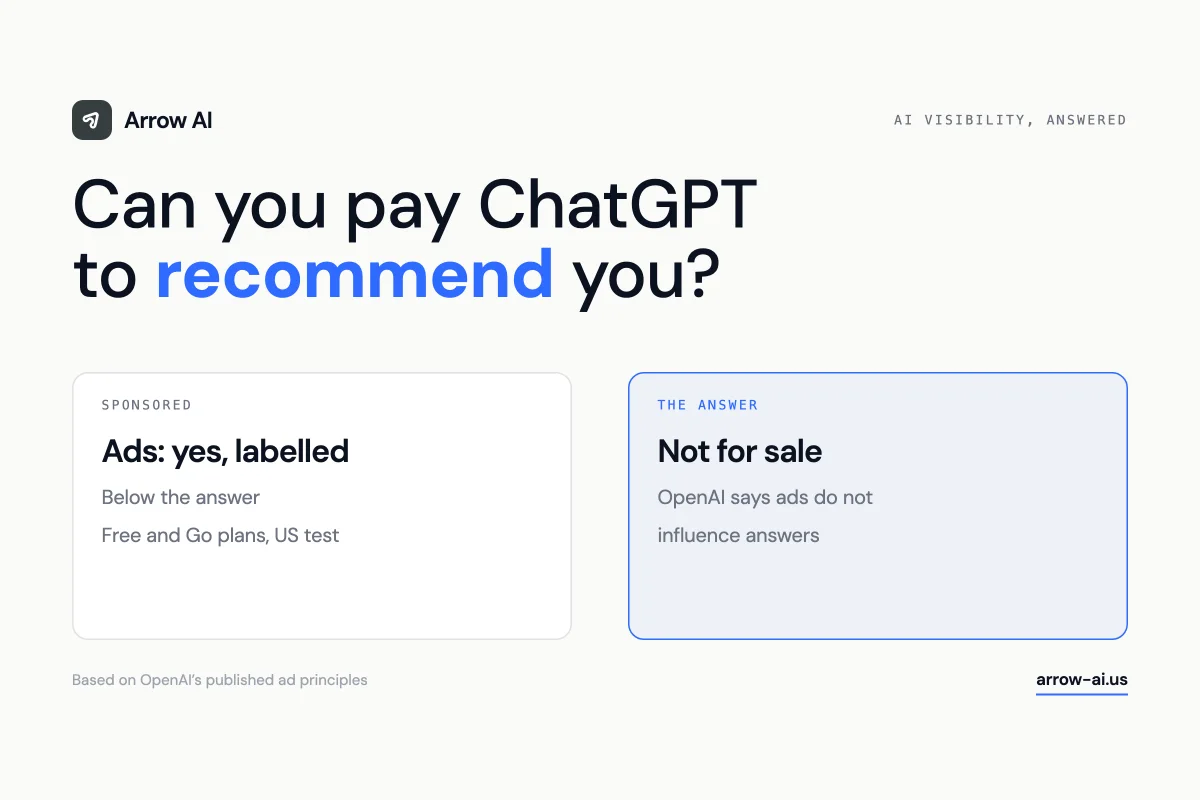
ChatGPT ads are a separate, labelled placement below answers, shown in a US test to adult users on the Free and Go plans; paid plans such as Plus and Pro do not show them. OpenAI says ads do not influence answers and that conversations are not shared with advertisers. Organic recommendations depend on relevance and evidence, and paying for undisclosed placements in articles creates legal and reputational risk.
What has OpenAI said about ads in ChatGPT?
Ads are being tested in the US, labelled, and kept separate from answers. OpenAI announced the test on 16 January 2026 (OpenAI, CNBC). Its advertising principles include:
- Answer independence — ads do not influence the answers ChatGPT gives.
- Conversation privacy — conversations are not shared with or sold to advertisers.
- Placement and labelling — ads appear below the answer and are clearly marked as sponsored.
- Limits — no ads for users identified as under 18, and none near sensitive topics such as health, mental health or politics.
- Plans — the test covers the Free and Go plans; Plus, Pro and Enterprise do not include ads.
OpenAI also runs a dedicated crawler, OAI-AdsBot, to check the landing pages of ads submitted to ChatGPT (OpenAI crawlers).
What is the difference between an ad and a recommendation?
| Sponsored ad | Organic answer | |
|---|---|---|
| Label | Marked as sponsored | No label |
| Position | Below the answer | The answer itself |
| What decides it | Your campaign, budget and targeting | Relevance to the question and the sources available |
| Who sees it | US adults on Free and Go plans (test) | Every user |
| How to measure it | Ad platform reporting | AI referrals, citations and answer tracking |
An ad can put you in front of a buyer at the right moment. It will not make the answer above it say you are the best choice.
What about paying for a spot in “best of” lists?
It can create mentions, but undisclosed deals are risky. Some companies pay publishers to be included in “best X” articles because AI systems often read and cite such lists. Three problems:
- Disclosure. In the US, the FTC’s Endorsement Guides expect material connections, such as payment, to be clearly disclosed.
- Search quality. Google’s spam policies target practices such as site reputation abuse, where third-party content is published mainly to exploit a host site’s ranking signals. Pages built that way can lose visibility.
- Credibility. A disclosed sponsorship carries less weight with readers, and an exposed undisclosed one can become the story people — and AI answers — repeat about you.
What actually influences recommendations?
Relevance, clarity and independent evidence. AI answers recommend businesses that plainly fit the question and are described consistently by credible sources:
- Pages that answer buyers’ real questions — prices, inclusions, limits, comparisons.
- Consistent facts across your site, profiles and directories.
- Genuine reviews and independent coverage.
- Accurate representation in the communities your buyers read (see why ChatGPT cites Reddit).
Our guide on why AI recommends your competitors shows how to find the gap.
How should you split effort and budget?
A simple decision aid, not a formula:
| If this is true… | Start with… |
|---|---|
| AI answers describe you wrongly or not at all | Fixing your source pages and public facts |
| Competitors are named with better evidence | Reviews, case proof and independent coverage |
| You are already cited and want more reach | Testing ads on commercial questions, measured separately |
Sources and editorial scope
This article describes OpenAI’s published advertising principles and the US test as reported in 2026; availability and rules can change by market. It is not legal advice.
- OpenAI — Testing ads in ChatGPT
- OpenAI — Our approach to advertising and expanding access to ChatGPT
- CNBC — OpenAI to begin testing ads on ChatGPT in the U.S. (January 16, 2026)
- OpenAI — Overview of OpenAI crawlers
- US Federal Trade Commission — FTC’s Endorsement Guides: What People Are Asking
- Google Search Central — Spam policies (site reputation abuse)
The Arrow read
Ads buy attention. Answers are earned.
If AI answers do not mention you today, advertising will not change what they say. Start with the sources those answers rely on — our free audit shows which ones describe you, and how.