 Arrow
Arrow 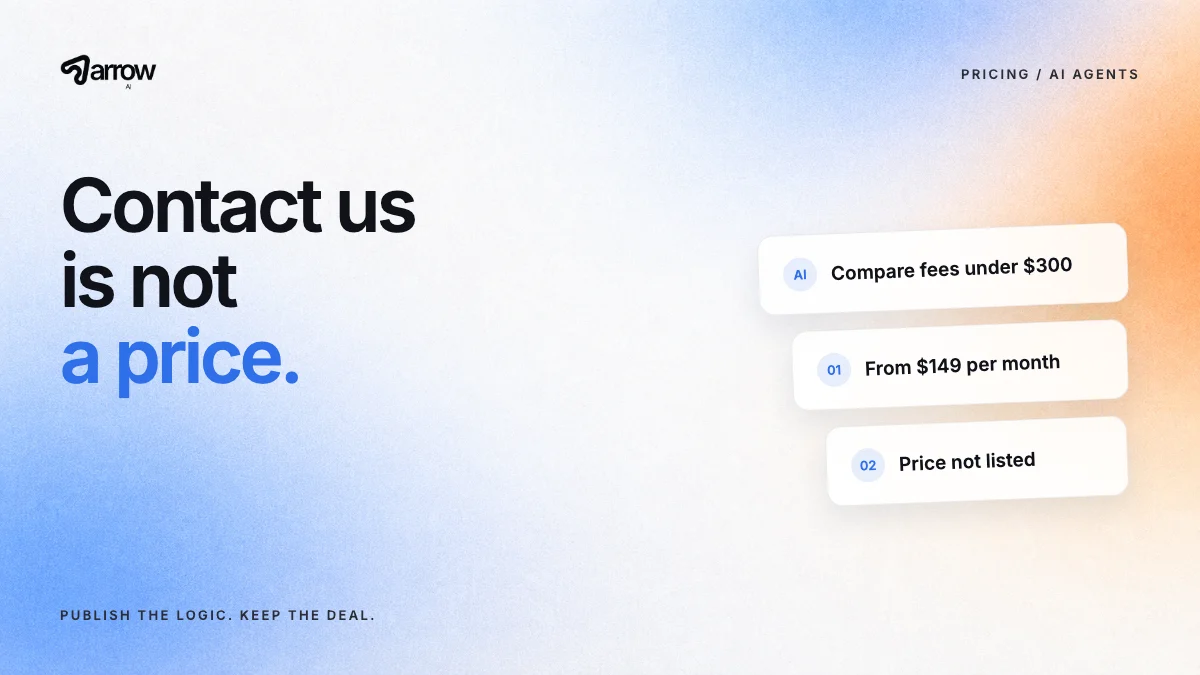
Contact us is not a price. Publish a price, a starting price, a range or a pricing rule in plain text with the currency and billing period. Agents comparing options within a budget favour vendors whose prices they can read.
Why does pricing matter so much to AI agents?
Budget is one of the most common constraints in a delegated task. "Find a provider under $500 a month" or "compare the three cheapest options" cannot be answered for a business that does not publish a price. An agent may still list you, but often with "price not listed", which weakens your position against competitors who answered the question.
This does not mean every business must publish a fixed price list. It means an agent needs something it can compare: a price, a starting price, a range or a pricing rule.
What can you publish if your prices are custom?
Most custom pricing still follows a logic. Publishing that logic gives an agent a comparable fact without locking you into a single number.
| Pricing model | What to publish | Example wording |
|---|---|---|
| Fixed | The price, currency and period | "$149 per month, billed monthly" |
| Starting price | The entry point and what raises it | "From $2,500 per project; most projects range $4,000–$9,000" |
| Unit-based | The unit and the rate | "$95 per hour, minimum two hours" |
| Tiered | Each tier with its limits | "Up to 10 users: $49; up to 50 users: $199" |
| Quote-only | The factors and a typical range | "Quotes depend on size and deadline; typical engagements start at $3,000" |
The figures above are illustrative. Use your own approved prices.
How should a pricing page be built for agents?
Put prices in plain HTML text. Prices inside images, PDFs or interactive calculators that need several clicks are harder to read and compare. State the currency, the billing period, taxes or fees and what is included in each option.
Keep one maintained pricing page and link to it from service pages instead of repeating numbers everywhere. Repeated numbers drift apart, and agents that find two prices for the same service have to guess. When prices change, update every profile that shows them; old prices are a common source of AI errors.
Mark up prices with schema.org Offer properties such as price, priceCurrency and description, and keep the markup identical to the visible text. See schema markup for AI agents.
What about competitors seeing my prices?
Competitors can already ask for a quote. Hidden prices protect you less than they seem to and cost you something new: comparisons made by agents for buyers who never call. Publishing a range or a starting price keeps room for negotiation while answering the buyer's first filtering question.
For regulated professions, check the rules before publishing fee information. Lawyers, for example, must avoid misleading statements about fees under ABA Model Rule 7.1 and state equivalents. See what US law firms should publish.
How do you test whether agents read your prices?
Ask an AI assistant with browsing to compare your price with two named competitors for a specific need. Check whether it quotes your current figure, an old one or none. If it quotes none, check that the price is in the page text, that the page is linked from your service pages and that crawlers can reach it.
Run the same request after each change and record the result. The agent-ready checklist includes pricing as check 7.
Sources and editorial scope
Reviewed October 1, 2026. Platform-specific statements link to the documentation beside the claim. The workflows and examples are Arrow AI editorial guidance. Agent features change quickly and vary by plan and country; check the linked documentation before acting. Fictional scenarios illustrate a method; they are not customer results, measured demand or evidence of ranking gains.
Part of Agent-Ready Business. Explore Arrow GEO or request a free audit to see which facts an AI agent can already find about your business.