 Arrow
Arrow 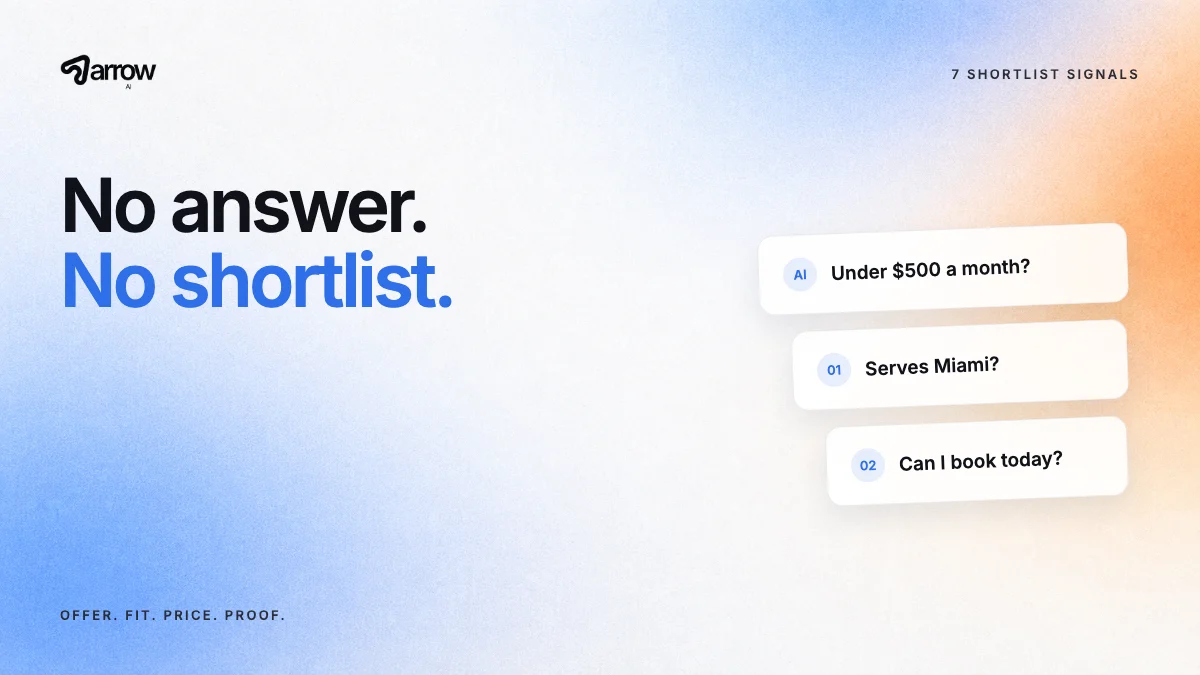
An AI agent keeps only the vendors it can match and verify. Seven signals decide it: offer, fit, price, availability, location, next step and proof. Missing or contradictory facts push a business off the shortlist.
How does an AI agent build a shortlist?
An AI agent builds a shortlist by turning a request into constraints, finding candidates and keeping only those it can match and verify. The constraints come from the person: a budget, a location, a deadline, a type of client. Each candidate is tested against them using whatever public information the agent can reach.
The seven signals below are Arrow AI's editorial framework for that test. They are not a published ranking algorithm. They describe the facts an agent needs in order to say "this option fits" with evidence.
What are the 7 signals an agent checks?
| # | Signal | The agent's question | What fails the test |
|---|---|---|---|
| 1 | Offer | Does this business do the thing requested? | Vague taglines with no service named |
| 2 | Fit | Is it for this type of customer? | No mention of size, sector or eligibility |
| 3 | Price | Can I compare it within the budget? | "Contact us" with no range or logic |
| 4 | Availability | Can it happen in the time required? | No hours, lead times or capacity |
| 5 | Location | Does it serve this place? | No service area or address |
| 6 | Next step | Can I book, buy or enquire? | Broken, hidden or image-only forms |
| 7 | Proof | Can I trust the claims? | Unattributed reviews, no dates, no cases |
A business that answers all seven gives the agent everything it needs to recommend it with confidence. One that answers four may still appear, but with caveats such as "price not listed".
Why does consistency matter as much as content?
Agents cross-check. If your website says you open at 8 a.m., your Google Business Profile says 9 a.m. and a directory says you closed last year, the agent has three contradictory facts. It may pick one, flag the uncertainty or prefer a competitor with a cleaner record.
The same applies to prices, service names and locations. Old prices on a cached page are a common cause; see why AI shows your old prices. A single, maintained source per fact and matching third-party profiles reduce that risk.
Which signal blocks a shortlist most often?
For many service businesses, price and next step are the easiest gaps to spot. Service pages often explain the expertise well and stop there. A person might call. An agent asked to "compare monthly fees" has nothing to compare.
Your own gaps may differ, which is why the agent-ready checklist starts with a test of your real pages rather than a general rule.
How can you test your own shortlist position?
Write three realistic delegated tasks for your market, including constraints. For example: "Find two accountants in Miami who handle crypto taxes and charge a fixed fee, and tell me their fees." Run each task in an assistant with agent or browsing features. Record which businesses were kept, which were dropped and the reason given.
Then compare your own pages with the seven signals. Each missing signal becomes a task: publish the price logic, add the service area, fix the form. Recheck the same task later under the same conditions.
What does a strong page look like?
A strong service page answers the seven questions in the first screen and the first few paragraphs: what the service is, who it is for, the price or price logic, availability, area, the action and one piece of dated proof. Everything else can follow. Read pricing pages AI agents can read for the signal most often missing.
Sources and editorial scope
Reviewed October 1, 2026. Platform-specific statements link to the documentation beside the claim. The workflows and examples are Arrow AI editorial guidance. Agent features change quickly and vary by plan and country; check the linked documentation before acting. Fictional scenarios illustrate a method; they are not customer results, measured demand or evidence of ranking gains.
Part of Agent-Ready Business. Explore Arrow GEO or request a free audit to see which facts an AI agent can already find about your business.