 Arrow
Arrow 
Yes. Buyers are using AI to discover and compare software, and some say it changes which vendor they choose. The useful distinction is between getting onto the shortlist and earning the purchase. Those are different jobs.
What does the evidence actually say?
There is evidence of reported behavior, not just forecasts. In G2’s March 2026 survey of 1,076 B2B decision-makers across North America, EMEA and APAC, 51% said they start software research with an AI chatbot more often than Google. Yet 80% still used Google somewhere in the buying journey. Read G2’s survey and methodology.
The same research found that 69% of respondents said an AI chatbot led them to select a different vendor than originally planned. That is self-reported influence, not transaction-level proof that AI alone caused the purchase. See the vendor-selection findings.
That distinction matters. “I used ChatGPT while researching” is a weaker claim than “ChatGPT introduced the product I bought.” Neither tells us whether the software worked well six months later. Keep discovery, evaluation, purchase and retention separate when reading an AI adoption headline.




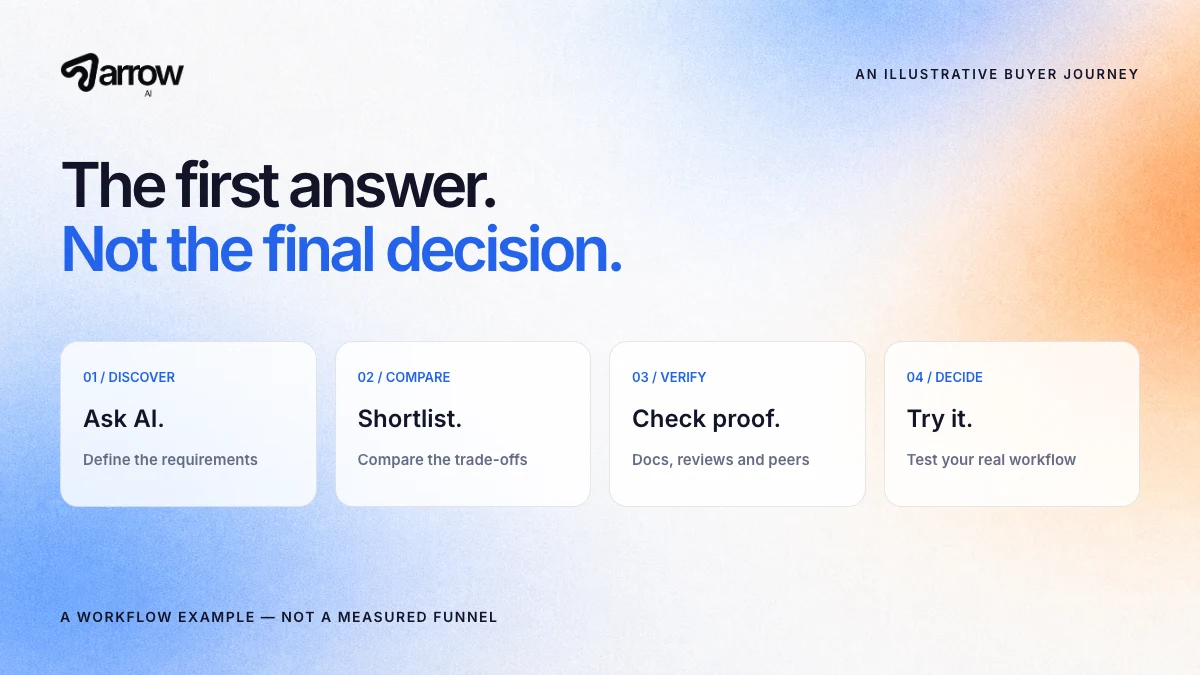
Illustrative sequence. Buyers can move back and forth.
What are buyers asking AI to do?
AI can turn a messy brief into a manageable comparison. A buyer can describe a team, a budget, existing tools and the problem they need to solve in one request. That is useful when a category contains dozens of similar products.
TrustRadius’s 2025 buyer-community research describes early research and product comparisons as prominent uses of AI. It also reports that most AI users check outputs against other sources. The study drew respondents from the TrustRadius network, so it should not be read as a census of all software buyers. Read the TrustRadius research.
A question such as “best project management software” can quickly become “which options support client approvals, guest access and exportable time reports for a 12-person team?” Follow-up questions let the buyer explore trade-offs without repeatedly reformulating a search query. Our guide to how B2B buyers use ChatGPT before visiting a vendor looks more closely at that evaluation stage.
Do people trust the recommendations?
Using a recommendation does not require accepting every claim inside it. A shortlist can be helpful even when a buyer intends to verify pricing, investigate negative reviews and reject unsuitable options.
For a software purchase, verification should concentrate on the details that can change the decision: whether the required feature exists on the proposed plan, what an integration actually supports, how a billing limit works and whether data can be exported. A confident summary cannot replace those checks.
Reddit and review sites can surface operational frustrations that a product page omits. They also need context: the review date, team size, plan and specific use case. A complaint about a missing capability from two years ago may no longer apply. Our articles on Reddit in AI answers and ChatGPT visibility explain why the evidence surrounding a product deserves attention.
Which part of Google search does AI replace?
For some buyers, AI replaces the first pass through a category and the work of assembling a comparison. It does not necessarily replace finding a primary source, checking a current limitation or investigating an unresolved concern.
Consider the difference between “give me five tools to consider” and “show me the current documentation for this integration.” The first asks for synthesis; the second asks for verifiable evidence. A buyer may switch between an assistant, Google, a community thread and a vendor’s help center during the same hour.
This is why an AI mention and a website visit should be measured separately. Someone can discover a brand in ChatGPT and later type its name into Google. The final visit alone may not reveal the original introduction. Read our guide to tracking AI citations for a framework that separates visibility from downstream activity.
Is it still mostly a tech-person habit?
The evidence supports use beyond technical roles, but it does not justify claiming that everyone shops this way. G2’s sample includes several industries and functions beyond IT. It remains a study of B2B software decision-makers, not the general public. See the report’s respondent scope.
Your own customers may behave differently by company size, language, buying authority or procurement requirements. A founder choosing a small monthly subscription and a team evaluating an enterprise system face different constraints. One can test a product that afternoon; the other may need technical review and purchasing approval.
A practical example: choosing a CRM
Illustrative example: a small sales team needs a CRM with shared email history, duplicate handling and a clean export. The process below is a decision aid, not a customer case study or a claim about any particular vendor.
Keep a simple record: requirement, source URL, date checked, uncertainty and trial result. If the assistant cannot substantiate a feature, label it “unverified.” A missing answer is a reason to investigate, not to assume that the feature exists.
What should SaaS companies do with this?
Make the product easy to evaluate, then check whether buyers and assistants describe it accurately. Start with a precise explanation of who it is for, supported workflows, limitations, plan boundaries and integrations. Give each important claim a page that a buyer can inspect.
Publish useful comparisons that acknowledge trade-offs. Keep your website, review profiles and LinkedIn company description consistent. Share specific product evidence on LinkedIn with links back to the relevant documentation. A social post is another place to explain the product; it is not a guaranteed route into an AI answer.
For a starting point, explore Arrow’s GEO platform, the difference between GEO and SEO and why an assistant may recommend a competitor. These are connected questions, but appearing in a response still does not prove that a buyer will convert.
To understand your own customers, ask at signup or after a purchase: “Where did you first hear about us?” and “What helped you compare your options?” Allow multiple answers and an optional free-text response. Combine this with referral data and customer interviews. Do not silently treat every direct visit as an AI-assisted purchase.
Sources and editorial scope
Reviewed September 30, 2026. This article interprets published surveys and provides an original illustrative buying workflow. Arrow did not conduct the cited surveys or independently observe respondents’ purchases. Both publishers operate software-review businesses; their samples and commercial context matter. No general-population adoption rate or revenue lift is claimed.
- G2: The Answer Economy (2026) — March survey of 1,076 B2B decision-makers; reported starting points and vendor influence.
- TrustRadius: From Buzzword to Backbone (2025) — research conducted through its buyer community; use cases and verification behavior.
The Arrow read
Earn the shortlist. Then earn the trust.
AI-assisted discovery makes clear, verifiable product information more useful. Start by checking what buyers can find about your business with the free Arrow AI visibility audit.
Follow Arrow AI on LinkedIn for more research and practical guides.