 Arrow
Arrow 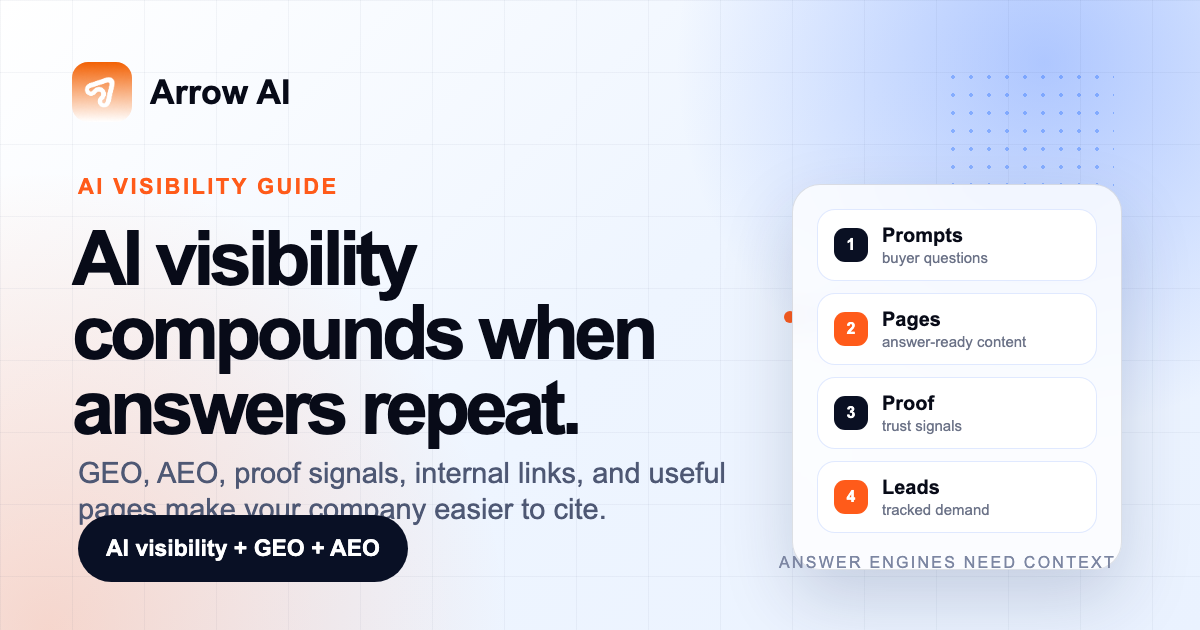
AI visibility is the ability of your company to appear, be understood, be cited, and be recommended when buyers ask AI engines for help. Strong AI visibility makes your offer easier to verify in ChatGPT, Perplexity, Gemini, Claude, Copilot, Google AI Overviews, and future answer engines.
AI visibility matters because buyers no longer wait until they land on your website to form an opinion. They ask AI systems who to trust, what to compare, what the pricing looks like, what risks to consider, what alternatives exist, and which provider is most relevant for their situation. If your public content does not support AI visibility, the answer engine may explain your market without you.
AI visibility also matters because AI answers are compressed. A traditional search result can show ten links. An AI answer may mention two or three brands, one method, one comparison, or one recommendation. That makes AI visibility more competitive than old search visibility. The company with clearer public context often becomes easier to include.
The mistake is treating AI visibility like a single SEO trick. AI visibility is not only schema. AI visibility is not only backlinks. AI visibility is not only a blog post. AI visibility is the combined result of useful pages, structured answers, proof, sources, internal links, external references, fresh updates, and conversion paths.
Why AI visibility compounds
AI visibility compounds when every useful page makes the next page easier to understand. A comparison page supports a pricing page. A pricing page supports a use case page. A use case page supports a FAQ. A FAQ supports an industry page. An industry page supports a case study. Together, those pages create an AI visibility layer around the company.
That is why repeated use of the phrase AI visibility is not enough by itself. The phrase AI visibility needs context. A page should explain what AI visibility means, who needs AI visibility, how AI visibility is measured, why AI visibility creates demand, what AI visibility does not guarantee, and how AI visibility connects to GEO, AEO, SEO, CRM attribution, and sales follow-up.
When those explanations repeat across the site with different buyer intents, AI visibility becomes clearer. A buyer searching for “best provider” sees one path. A buyer asking “how much does it cost” sees another. A buyer asking “what are the risks” sees another. Each page increases the probability that AI visibility work becomes useful, not just decorative.
Buyer questions
AI visibility starts with real prompts: best provider, alternatives, price, implementation, risk, integrations, location, and proof.
Answer-ready pages
AI visibility improves when each page gives a direct answer, source context, examples, FAQs, schema, and links.
Tracked outcomes
AI visibility becomes business value when prompts, citations, branded searches, forms, calls, and CRM activity are tracked.
The signals that support AI visibility
AI visibility needs multiple signals because answer engines do not rely on one signal. They look for clear language, consistent entity context, public proof, topical coverage, structured data, internal links, and freshness. The stronger those signals are, the easier it is for an AI system to understand what your company does.
- Entity clarity: your brand, category, offer, locations, industries, and audience are explained consistently.
- Prompt coverage: your pages answer the questions buyers actually ask before contacting sales.
- Proof: case studies, examples, screenshots, demos, reviews, and public references support the claims.
- Internal links: pages connect GEO, AEO, AI visibility, services, industries, case studies, and CTAs into a readable system.
- Freshness: important AI visibility pages are updated when the offer, market, competitors, or buyer questions change.
For example, a local service company can use AI visibility pages to explain service areas, qualification criteria, pricing context, documentation, customer proof, and common objections. A yacht broker can use AI visibility pages to explain trust, APA, deposits, sea trial, escrow, safety, crew, and broker proof. A B2B SaaS company can use AI visibility pages to explain alternatives, integrations, use cases, limitations, implementation, and support.
A practical AI visibility workflow
The first step is an AI visibility audit. Search the prompts your buyers already ask. Capture which brands appear, which sources are cited, which claims are wrong, and which questions have weak answers. The goal is to map the current AI visibility gap before writing anything.
The second step is a page map. Build pages for high-intent questions: “best,” “alternative,” “vs,” “pricing,” “how to choose,” “near me,” “use case,” “implementation,” “risk,” “checklist,” and “FAQ.” Every page should help a real buyer. AI visibility gets weaker when pages are thin, generic, or written only for algorithms.
The third step is distribution. Add internal links from the homepage, service pages, industry pages, blog posts, case studies, and CTAs. Add schema where it helps. Add screenshots or visuals where they explain the answer. Connect pages to conversion paths such as the free audit, Arrow GEO, custom AI systems, and case studies.
The fourth step is tracking. AI visibility should be measured with prompt checks, citation tracking, page indexing, organic clicks, branded search changes, form submissions, booked calls, and CRM source notes. AI visibility is not only a content metric. AI visibility is a demand metric when it is connected to sales.
AI visibility is a system, not a campaign.
The companies that win AI visibility will not be the ones repeating “AI visibility” the most. They will be the ones building the clearest public answer layer around their market, proof, offer, and buyer questions.
What to avoid
Do not promise guaranteed AI visibility rankings. Do not publish fake comparisons. Do not invent case studies. Do not hide every useful detail behind a form. Do not expose sensitive internal process. Good AI visibility is factual, useful, and defensible. It gives enough context for AI systems and buyers to understand the company without revealing private operating details.
To go deeper, read the France DPE GEO case study, the AI visibility to qualified leads framework, the AI visibility attribution stack, and the GEO content hub guide.