 Arrow
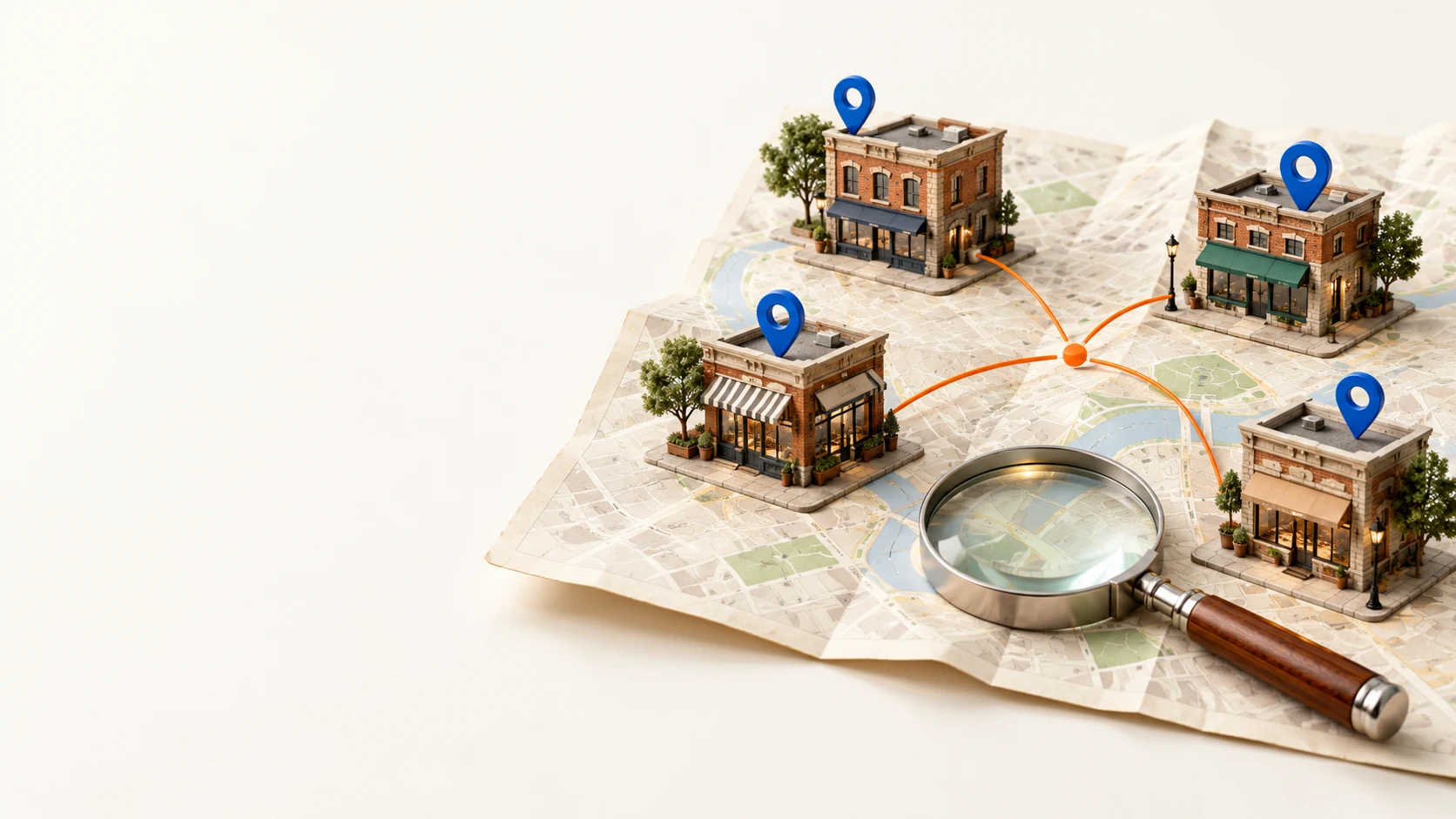
Create a location register and run comparable questions with explicit place context. Verify the actual location settings, evidence and plan limits; a country setting does not by itself establish neighbourhood-level coverage.
Define what a location means to your business.
A physical branch, a service area and a parent office are different records. List the name, actual contact route, relevant services and responsible reviewer for each one. Do not count a marketing landing page as proof of a staffed premises.
Include shared facts and local exceptions. A location can belong to the same brand while having different opening hours, appointments or available services. The trial should be able to reveal those differences rather than flattening them into the group description.
Keep the location attached to the evidence.
- 01RegisterThe real branch or area.
- 02AskA defined local need.
- 03VerifyThe named location.
- 04AssignA local correction owner.
Check the precision of the observation.
Ask which location or market controls are available and how they affect the collection method. Peec AI’s country-setting documentation describes prompt location scope. A country control should not be described as evidence of a precise neighbourhood test.
Record the location stated in the question separately from any verified platform setting. If device location or personalization is unknown, keep it unknown. Comparable observations require more than adding a city name to an otherwise changing prompt.
Do not merge these three levels.
Country
A market setting.
Question
The place named by the buyer.
Branch
The actual service location.
Inspect the right branch in the answer.
Check whether the response names the correct location and gives a usable contact route. A recommendation of the parent brand may not resolve which branch can perform the job. Keep a wrong-location result distinct from a completely absent business.
The fictional example below uses two branches with different services. It demonstrates why a network needs local facts as well as brand visibility. It does not assert that any monitoring product can deliver every geographic level.
A brand mention can still send a buyer to the wrong place.
Both branches share the brand name.
Only one offers the required service.
Record which branch the answer identifies.
Verify that branch’s actual service, hours and contact route.
Keep local identity accurate.
Google’s representation guidelines are a reference for truthful profiles. Describe real premises and service areas, and give each page its actual offer. Do not create fictional addresses to expand coverage.
Google’s local ranking guidance concerns its own local results. Do not export it as a universal formula for other assistants. Test the surfaces that your buyers use and retain their names in the report.
Plan a rollout the locations can maintain.
Start with a few locations and a consistent question set. Record how shared corrections are distributed and which details need local approval. A reporting workflow that fails at three branches is unlikely to become easier at thirty.
Ask about project limits, additional charges, exports and access before expanding the subscription. Continue with local service visibility and the data portability checklist.
Sources and editorial scope
This is Arrow AI editorial guidance. Diagrams and examples illustrate a method, not client results or platform ranking factors. Clear information and source access do not guarantee a recommendation. Platform-specific facts are attributed to the sources below.
The Arrow read
Make the next decision clearer.
See what your customers can understand today, then improve the source or workflow that answers their next question. Start with a free GEO audit.