
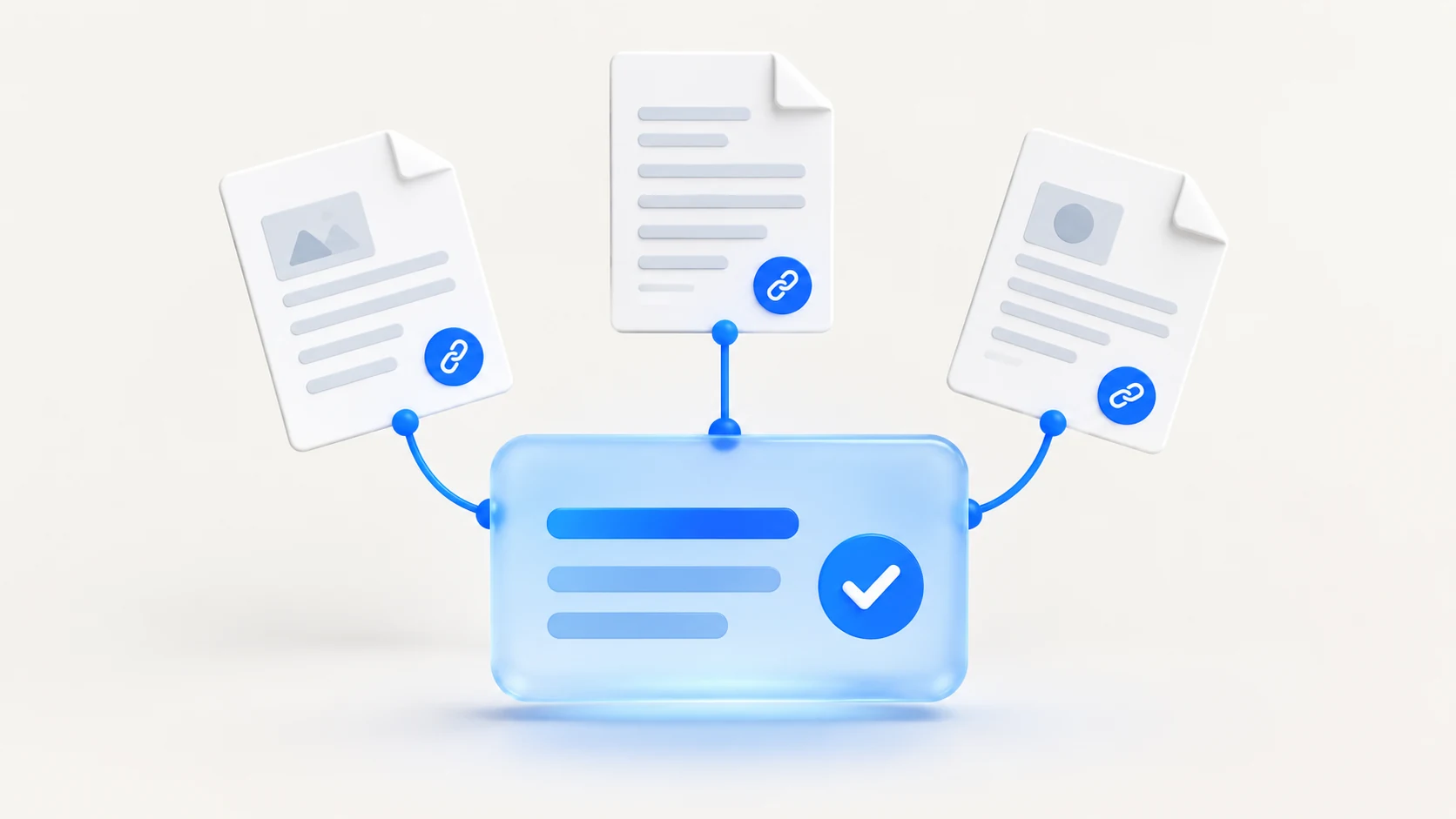
An answer hub is a structured, machine-readable section of your site — real buyer questions, one direct answer per entry, backed by schema — built specifically so ChatGPT, Claude, Gemini, Perplexity, Grok, Microsoft Copilot, and Google AI Overviews can lift a clean answer and attribute it to you. It only works if every entry is genuinely distinct: swap an engine name or an industry name into an identical template and you get near-duplicate pages that engines learn to skip, not cite.
Most companies that try to "get cited by AI" ship a wave of thin, near-identical posts: same structure, same headings, same three paragraphs, with only the AI engine's name or the target industry swapped out. It reads like content to a machine built to detect exactly that pattern, and it reads like noise to a human who lands on two of them in a row. The pages don't get cited — they get quietly deprioritized, and often they drag down the rest of the site's credibility with them.
This is the guide to use instead of that approach. It covers what each of the seven major AI answer engines structurally needs to treat a page as citable, a side-by-side comparison of what markup and format each one favors, and genuinely different guidance for three buyer contexts — fintech, France DPE (diagnostic de performance énergétique) providers, and local service businesses — that have almost nothing in common except that their buyers now ask AI engines the first question.
What an answer hub actually is
An answer hub is not a blog and it is not a generic FAQ page bolted onto a footer. A blog post can meander through context before it gets to the point; an AI engine deciding whether to cite you usually only has a paragraph or two to work with, so an answer hub entry has to answer the question in its first sentence and stand on its own if it's pulled out of context entirely. A generic FAQ page fails for a different reason: it's usually written for humans skimming a support page, with answers that lean on the question above it or the page's intro for context. An answer hub entry can't do that — it has to be self-contained.
The other requirement is entity clarity. Every AI engine is trying to figure out what you are, who you serve, and how your answer relates to established facts it already trusts. That means naming your company, your product, and any technical term the first time it appears, rather than writing the vague, brand-voice-first copy that reads well on a landing page but gives an engine nothing concrete to verify or attribute. Pair that with the right schema — FAQPage, HowTo, Organization, LocalBusiness, or FinancialProduct depending on the content — and you've given every engine below a structurally sound page to work from.
Build for each AI engine
The seven engines below don't read the web the same way, and a hub that only optimizes for one of them will under-perform on the rest. Here's what each one specifically needs.
ChatGPT
ChatGPT reads the live web through OpenAI's search retrieval layer and crawls separately for training via GPTBot, so two different systems need to parse your hub. Put the question in an H2 or H3, answer it in the first sentence, then add supporting detail below. FAQPage schema helps ChatGPT's search tool extract the Q&A pairs cleanly, and numbered lists get lifted almost verbatim — write them the way you'd want them to appear inside a chat reply, with no "as shown above" that depends on surrounding page context.
Claude
Claude crawls via Anthropic's ClaudeBot and, with web search enabled, retrieves live pages mid-conversation. Its strength is synthesis across multiple sources rather than lifting a single line, so it rewards pages that make relationships between concepts explicit — comparisons, cause-and-effect, and precise one-sentence definitions rather than adjective-heavy marketing copy. Claude is also more sensitive than most engines to visible authorship and organizational identity, so a real author, a real "About" page, and claims that stay consistent across your site all raise the odds it treats a page as citable rather than promotional.
Gemini
Gemini and Google's AI features sit on top of the standard Google index, so ordinary technical SEO — crawlable, indexable, fast, mobile-friendly — is a prerequisite before any of this matters. On top of that baseline, Gemini leans hard on schema.org markup (FAQPage, HowTo, Organization, LocalBusiness) to connect your hub entries to the Knowledge Graph. E-E-A-T signals — real authorship, citations to primary sources, consistent business details — carry more weight here than on any other engine, because Gemini shares Search's trust model.
Perplexity
Perplexity's whole interface is built around visible citations, so it needs your page to look citable at a glance: a clear published or updated date, one factual claim per paragraph, and links out to primary sources — regulators, standards bodies, original research — where relevant. PerplexityBot crawls the open web directly and favors pages that get revised as facts change, so a hub that never updates will slowly lose ground to a newer, fresher one on the same topic. Perplexity also pulls heavily from forums, so a hub entry that gets discussed or linked from a relevant subreddit or industry forum reinforces the citation.
Grok
Grok, built by xAI, has native access to real-time activity on X alongside a general web crawl, and it leans conversational and blunt rather than corporate. Plain sentences with real numbers and no hedging outperform landing-page phrasing. Because Grok's retrieval draws on what's circulating on X, a hub entry a person could quote in a single post — a clear number, a clear yes or no, a clear step — is more likely to surface than a paragraph that needs three sentences of throat-clearing before the actual point.
Microsoft Copilot
Copilot runs on Microsoft's Prometheus model over the Bing index, so it responds to classic Bing SEO signals: verified Bing Webmaster Tools ownership, IndexNow submission for fast re-crawling after an edit, and schema.org markup. Because Copilot lives inside Windows, Edge, and Microsoft 365, it also leans toward turning answers into completed tasks — structure comparison and how-to entries as literal numbered steps rather than narrative prose, since Copilot frequently converts them directly into a checklist for the user.
Google AI Overviews
AI Overviews draw from the same index as Google Search using passage-level ranking, meaning a single well-formed paragraph buried inside a long page can get pulled into an Overview even if the page as a whole doesn't rank first. Phrase H2 and H3 headings as the actual question a buyer would type, answer it directly in the first 40–60 words beneath the heading, and back it with FAQPage or HowTo schema. Overviews are also more conservative on YMYL topics — finance, health, legal — so pages in those categories need visible authorship, sourcing, and disclaimers to be eligible for citation at all.
Engine comparison table
A quick reference for what each engine reads and what earns the citation. Use it to check a hub entry before you publish it — if it doesn't satisfy at least the row for your priority engine, it isn't ready.
| Engine | Primary index / crawler | Format it favors | What earns the citation |
|---|---|---|---|
| ChatGPT | GPTBot (training) + Bing-backed live search | Direct-answer H2/H3, FAQPage schema, numbered lists | Self-contained, quotable answers |
| Claude | ClaudeBot + live web search tool | Explicit entity definitions, comparison structure | Clear relationships, visible authorship |
| Gemini | Googlebot / Google index + Knowledge Graph | FAQPage, HowTo, Organization/LocalBusiness schema | E-E-A-T signals, fast and indexable pages |
| Perplexity | PerplexityBot + live web search | One claim per paragraph, dated, sourced | Recency and links to primary sources |
| Grok | xAI crawler + X (Twitter) activity | Short, plain, quotable statements | Discussion on X, concrete numbers |
| Microsoft Copilot | Bingbot / Bing index (Prometheus) | Schema.org markup, numbered steps | Bing Webmaster verification, task-shaped content |
| Google AI Overviews | Google index, passage-level ranking | Question-phrased headings, 40–60 word direct answers | FAQPage/HowTo schema, YMYL sourcing |
Notice the overlap: FAQPage schema, a direct first-sentence answer, and a real publish or update date satisfy most rows at once. The differences are in the details — Grok wants it quotable on X, Copilot wants it step-shaped, Gemini wants it backed by E-E-A-T. Write for the overlap first, then adjust individual entries toward whichever engine matters most for your buyers.
Build for your industry
The format above is universal. What buyers actually need to know is not. A fintech buyer, a French property owner checking a DPE requirement, and a homeowner searching for an emergency plumber are asking fundamentally different questions, and an answer hub that gives all three the same generic treatment fails all three.
Fintech
Fintech answer hub entries need numeric precision with an "as of [date]" stamp on every rate, fee, or threshold — numbers in this category go stale fast, and an undated figure reads as unreliable to both buyers and AI engines. Add explicit disclaimers that separate information from advice, cite the applicable regulator (the SEC, FINRA, the CFPB, or the relevant national or EU authority) by name, and use FinancialProduct schema where it applies. Comparison tables of fees or rates work well here, but only with the date attached — AI engines are visibly more conservative about financial claims than almost any other category, and an unqualified number is one of the fastest ways to get an answer skipped rather than cited. Security and compliance certifications — SOC 2, PCI-DSS — belong near the top of the page as trust signals, not buried in a footer.
France DPE providers
A diagnostic de performance énergétique answer hub has to be written in real French, not a keyword swapped into an English template — the buyers, the regulations, and the search behavior are all French. Cite ADEME and the Loi Climat et Résilience directly rather than paraphrasing them, and explain the A–G letter-grade system in plain terms, since most buyers land on a DPE page not knowing what their own grade means. Build city- or region-level entries ("diagnostiqueur DPE Lyon," for example) rather than one national page, because these are location-bound licensed professionals and buyers search locally. Address the real estate context explicitly — what a notaire or agence immobilière needs at sale or lease — and answer the regulatory questions that actually drive traffic: how long a DPE stays valid, what the passoire thermique rental restrictions mean for a given grade, and the penalties for a missing or expired diagnostic.
Local service businesses
Local service hubs live or die on LocalBusiness or Service schema with an explicit service-area radius — without it, an AI engine has no reliable way to know whether you actually cover the buyer's zip code. Pair that with aggregateRating schema tied to real, embedded reviews, since "near me" answers lean heavily on social proof, and keep name, address, and phone details identical across every directory and citation — inconsistency here is one of the fastest ways to get quietly dropped from local answers. Structure entries around the practical questions a buyer actually has before they call: same-day or emergency availability, typical pricing ranges, and exact coverage area, rather than generic "why choose us" copy that answers nothing an AI engine can act on.
The Arrow read
One hub, seven engines, three industries — not eighty-four thin pages
The instinct to publish a page for every engine-and-industry combination is understandable, but it produces exactly the near-duplicate pattern AI engines are built to filter out. One comprehensive hub, written to satisfy the overlap across all seven engines and genuinely differentiated by industry, outperforms a dozen thin ones every time — and it's easier to keep current. See how Arrow's GEO approach builds hubs like this, read the deeper walkthroughs on building a content hub for AI answers and adding an answer hub without rebuilding your site, browse real answer hub examples for B2B companies, or start with the fundamentals of FAQ pages built for GEO. Then run the free audit to see where your own site stands today.
The 6-step build plan
- Map real buyer questions per engine and industry. Pull them from support tickets, sales call transcripts, and each engine's own related-questions or autocomplete — not from guessing what sounds good.
- Write one direct, self-contained answer per question. The first sentence has to answer it; nothing in the entry should depend on context from elsewhere on the page.
- Mark it up correctly. Match the schema to the content type — FAQPage, HowTo, Organization, LocalBusiness, or FinancialProduct — rather than copying one schema block across every entry.
- Differentiate by audience honestly. The same question gets a genuinely different answer for a fintech buyer, a France DPE buyer, and a local service buyer — not a find-and-replace of the industry name.
- Submit and verify. Push updates through IndexNow for Bing and Copilot, submit to Google Search Console for Gemini and AI Overviews, and confirm GPTBot, ClaudeBot, and PerplexityBot aren't blocked in robots.txt.
- Track citations, not rankings. Monitor which engines actually quote you, revise entries that go stale, and retire anything nothing cites rather than leaving it to dilute the rest of the hub.