 Arrow
Arrow 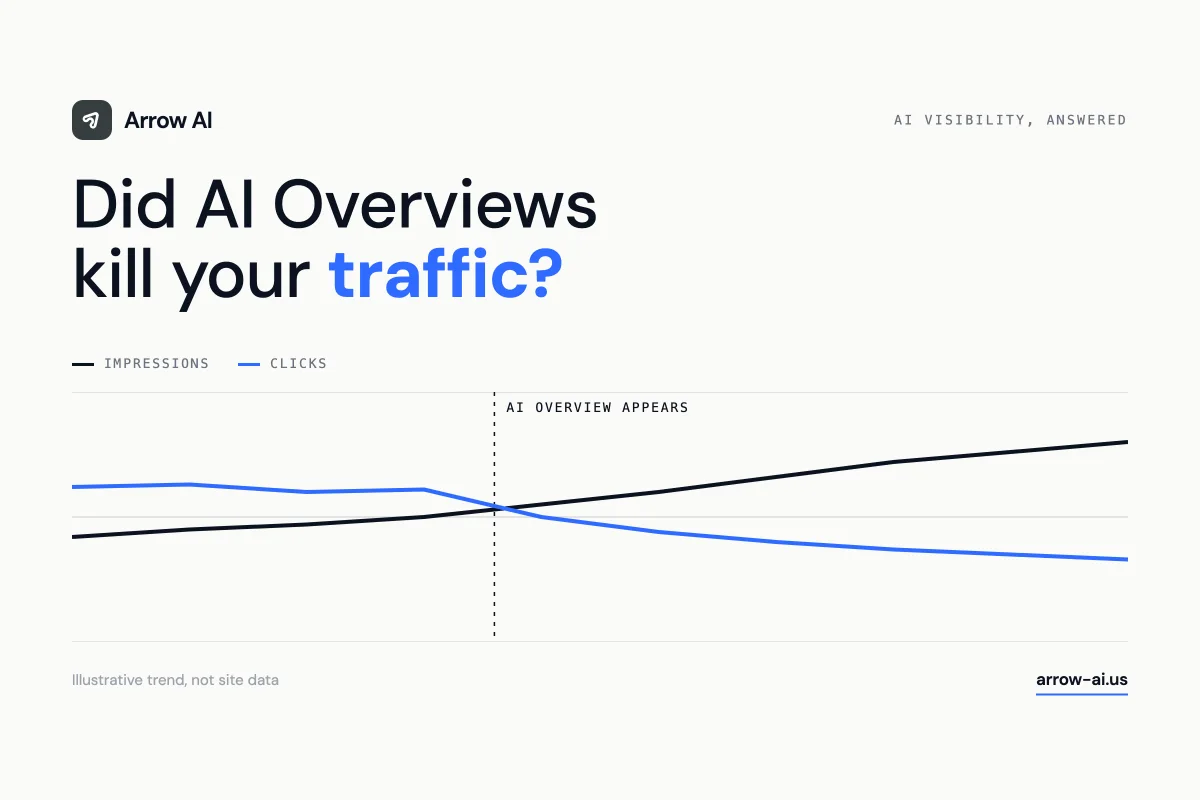
Look for queries where your average position held but your click-through rate fell, then check whether those pages receive impressions in Search Console’s generative AI performance report (AI Overviews and AI Mode, impressions only). If they do, AI summaries are a likely cause. If positions fell too, it is a ranking problem. Rule out tracking changes and seasonality first.
What does the research say about clicks?
Independent data shows fewer clicks when an AI summary appears. Pew Research Center analysed March 2025 browsing data from 900 US adults and 68,879 Google searches. Users clicked a traditional result in 8% of visits with an AI summary, compared with 15% without one; they clicked a link inside the summary in 1% of visits, and ended their browsing session more often (26% against 16%).
Google’s own guidance says clicks from results pages with AI Overviews tend to be higher quality, with people spending more time on the site (AI features and your website). Both can be true: fewer clicks, better clicks. Your data decides which matters more for you.
What does Search Console’s new AI report show?
Impressions in AI Overviews and AI Mode — not clicks, CTR or queries. Google introduced the generative AI performance reports in June 2026, and the Search Console Help page says they reached all websites worldwide on 31 August 2026.
| Included | Not included |
|---|---|
| Impressions of links to your site in AI Overviews and AI Mode | Clicks, CTR, average position |
| Pages (by canonical URL), countries, devices, dates | Queries |
| Trends by day, week or month | Search Labs experiments |
Clicks from AI features are still counted in the main Performance report, under the Web search type, mixed with everything else. The newest days can be preliminary (Search Console Help).
A five-step method to diagnose the drop
- Confirm the drop is real. Compare Search Console clicks with GA4 organic sessions, check for tracking or consent changes, and compare with the same period last year.
- Find “stable position, lower CTR” queries. In Performance → Search results (Web), compare two periods and sort by clicks lost. Queries whose position held but whose CTR fell are your candidates.
- Check AI impressions for those pages. Open the generative AI performance report and filter by the same pages. Rising AI impressions on a page with falling CTR point to AI summaries.
- Look at the results page itself. Search your top queries in a clean browser from the right country: is there an AI Overview, and is your page one of its links?
- Segment before deciding. Separate brand from non-brand and informational from commercial queries; they rarely behave the same way.
What does a worked example look like?
Illustrative data, not a client result. Three query groups, two comparable months:
| Query group | Avg. position | CTR | AI impressions on the page | Likely cause |
|---|---|---|---|---|
| “how to…” guides | 3.1 → 3.0 | 6.2% → 3.1% | Rising | AI summaries answer the question |
| Pricing pages | 2.4 → 5.8 | 9.0% → 4.2% | None | Ranking loss, not AI |
| Brand name | 1.0 → 1.0 | 48% → 47% | Low | No meaningful change |
Only the first group is an AI Overview effect. Treating the whole drop as “AI killed our traffic” would hide the ranking problem on the pricing pages.
What should you do next?
- For informational pages: accept that some answers will be zero-click, and aim to be one of the cited links. Put the direct answer first, back it with evidence, and add what a summary cannot give: tools, data, templates and a clear next step. See how to show up in Google AI Overviews.
- For commercial pages: recover rankings first; they matter more than AI impressions.
- Everywhere: track AI referrals in GA4’s AI Assistant channel and build channels you own — email, community, video.
Be careful with blunt fixes. A nosnippet rule limits how a page appears in regular results as well as in AI features (Google’s robots meta tag documentation), and it will not bring back clicks for questions people now answer without clicking.
Sources and editorial scope
Research figures come from Pew Research Center’s 2025 study; Search Console features are described as documented in September 2026. The worked example is illustrative and does not describe a real site.
- Pew Research Center — Google users are less likely to click on links when an AI summary appears (July 22, 2025)
- Google Search Central Blog — Introducing Search generative AI performance reports in Search Console (June 2026)
- Search Console Help — Generative AI performance report (Search)
- Google Search Central — AI features and your website
- Google Search Central — Robots meta tag and nosnippet rules
The Arrow read
A traffic drop needs a diagnosis, not a scapegoat.
We often find that part of a “lost to AI” drop is a ranking or tracking issue that can be fixed. Our free audit separates the two and shows where your pages already appear in AI answers.