 Arrow
Arrow 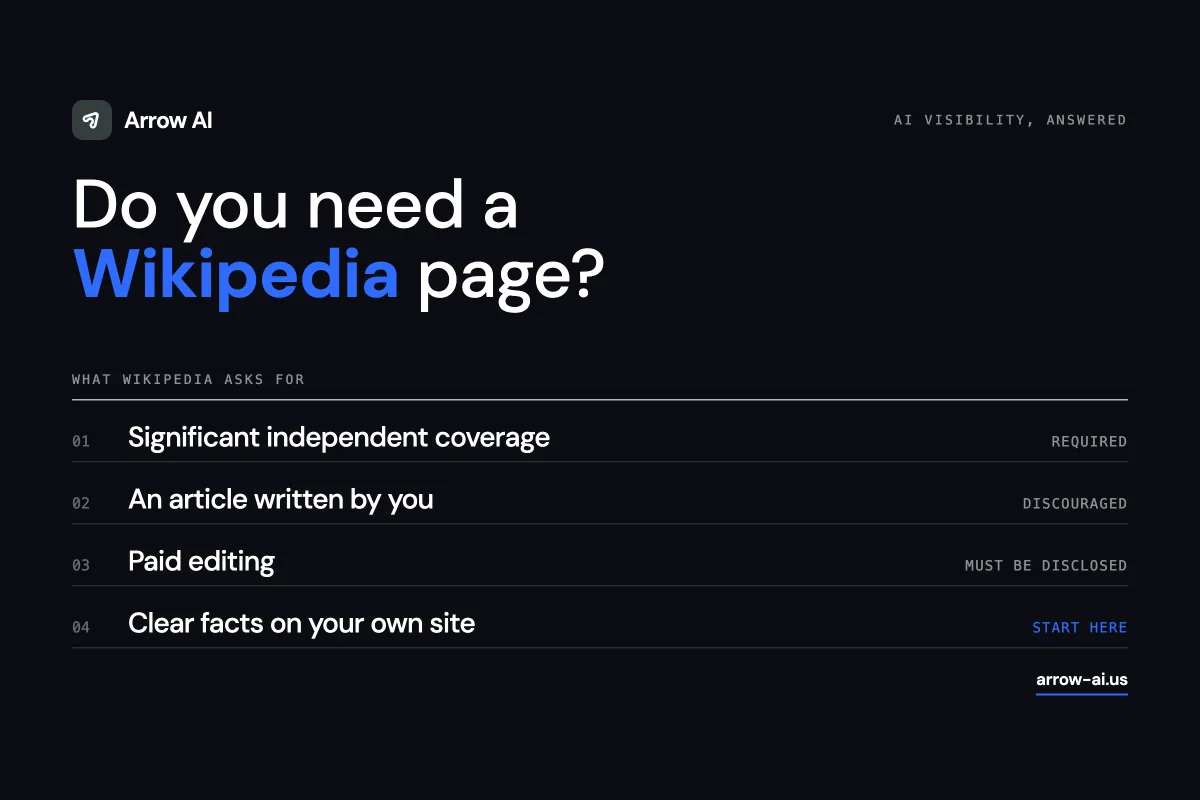
A Wikipedia article can help AI systems identify a company, but it is not required to appear in ChatGPT and most businesses do not qualify. Wikipedia requires significant coverage in independent, reliable sources, discourages editing about your own company, and requires paid editing to be disclosed. Start with a clear About page, consistent profiles, matching structured data and real independent coverage.
Why does Wikipedia show up in AI answers?
Because it is definitional, structured, heavily linked and widely reused. A good Wikipedia article states what an organisation is, where it operates and what it is known for, with citations. That makes it useful to search engines and to AI systems that need to tell entities apart — which is why it appears so often in answers about well-known companies.
For most small and mid-sized businesses the question is not whether Wikipedia is influential, but whether an article is possible at all.
Would your company qualify for an article?
Only with significant coverage in multiple independent, reliable, secondary sources. Wikipedia’s notability guideline for organizations and companies notes that only a small share of the world’s organisations meet it.
| Usually counts | Usually does not count |
|---|---|
| In-depth articles by independent journalists | Press releases and announcements |
| Books or academic studies discussing the company | Paid or sponsored placements |
| Substantial coverage in major trade publications | Directory listings and brief mentions |
| Analysis by credible sources over time | Your own website and social profiles |
An essay popular with editors sums it up: notability cannot be purchased.
Can you write the article yourself?
Wikipedia strongly discourages it. Its conflict-of-interest guideline asks people with a financial connection to avoid editing articles about their organisation directly and to suggest changes on the article’s talk page instead. Paid editing must be disclosed under the Wikimedia Terms of Use.
Undisclosed promotional articles tend to be tagged, rewritten or deleted — and the edit history remains public. If your company is genuinely notable, the durable path is independent coverage first, then a disclosed request for editors to consider an article.
Is Wikidata a shortcut?
No. Wikidata is a separate project with its own notability policy: items should describe clearly identifiable entities supported by serious, public references. A legitimate item can help systems disambiguate a company with a common name, but creating one purely for marketing breaks the spirit of the policy and is likely to be removed.
What should you do instead?
Build the evidence Wikipedia would require, on sources you can legitimately influence.
- An unambiguous About page — who you are, what you do, where, since when, and for whom. See what your About page should say.
- Structured data that matches the page — Organization details consistent with visible facts (schema markup for GEO).
- Consistent profiles and directories — the same name, address, services and dates everywhere (why directories disagree).
- Earned independent coverage — trade press, local news, podcasts and partners describing your work.
- Monitoring — check what AI says about your business after each change.
Sources and editorial scope
This article summarises Wikipedia and Wikidata guidelines as published in September 2026. It is not legal advice, and it does not suggest that any business should create or commission an article.
- Wikipedia — Notability (organizations and companies)
- Wikipedia — Conflict of interest guideline
- Wikipedia — Notability cannot be purchased (essay)
- Wikimedia Foundation — Terms of Use (paid contributions disclosure)
- Wikidata — Notability policy
The Arrow read
Be the kind of company a source would write about.
The work that makes a Wikipedia article possible — independent coverage, consistent facts, visible proof — is the same work that makes AI answers describe you correctly. Our free audit maps where your public record is thin or inconsistent.