 Arrow
Arrow 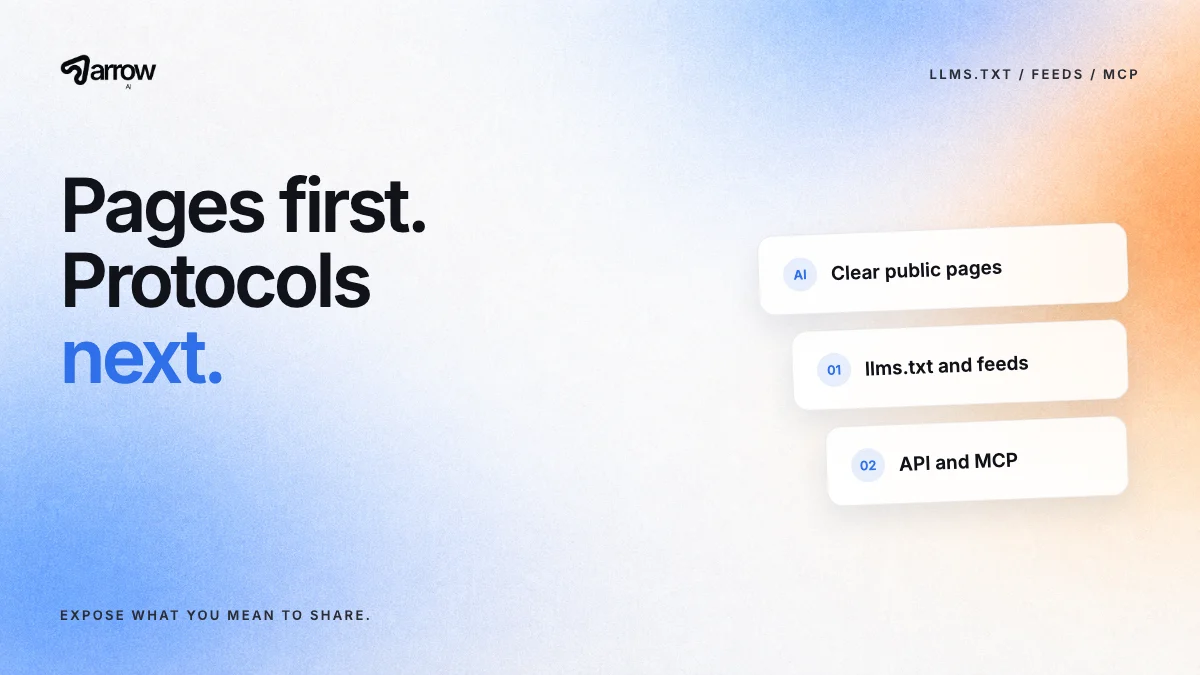
Clear public pages come first. Add llms.txt as a low-cost index, a product feed if you sell products, and an API or MCP server only when agents need live data. Expose only what you intend to share.
Do you need to give AI agents direct access to your data?
Most businesses do not need to start there. AI agents mainly read public web pages, so clear and current pages come first. Direct data access, such as a product feed, an API or an MCP server, becomes useful when an agent needs information that changes often or that cannot sit on a public page: live stock, real-time availability, order status or account details.
What are the options, from simplest to most advanced?
| Option | What it is | Who it suits | Effort |
|---|---|---|---|
| Clear public pages | Offer, price, hours and proof in readable text | Every business | Low |
| llms.txt | A Markdown file at your site root pointing models to key pages | Sites with many pages or docs | Low |
| Product feed | A structured file of products, prices and stock | Retailers and catalogue sellers | Medium |
| Commerce protocol | A standard such as the Agentic Commerce Protocol for checkout in an assistant | Merchants selling online | Medium to high |
| API | Programmatic access to live data | Software and data-rich services | High |
| MCP server | A standard way for AI applications to call your tools and data | Software vendors and platforms | High |
What is llms.txt, and is it worth adding?
llms.txt is a proposed convention: a Markdown file at `/llms.txt` that summarises your site and lists the pages a language model should read first. It is cheap to create and maintain. It is not an official standard, and no major provider has committed to using it for ranking. Add it as a helpful index, not as a substitute for good pages. Arrow's llms.txt guide explains the format.
When does a product feed matter?
When you sell products and want them to appear accurately in shopping experiences. A feed gives the price, availability and attributes of every product in one structured file, which reduces errors from scraped pages. Retailers already maintaining a Google Merchant Center feed have a head start. See GEO for e-commerce product pages for the page side.
What is MCP, in plain words?
The Model Context Protocol is an open standard that lets an AI application connect to external tools and data sources through a common interface. A software company can publish an MCP server so an assistant can, with the user's permission, look up account data or perform an action in its product.
For a service business with a brochure website, MCP is rarely the first priority. For a SaaS product, a marketplace or a booking platform, it can make your product usable directly inside assistants that support it.
What are the risks of exposing data?
Anything you expose can be read, so expose only what you intend to share. Keep authentication on anything personal or account-specific, log access and set rate limits. An API or MCP server is software to maintain: if it returns stale data, it spreads the error faster than a page would.
How should you decide?
Ask three questions. Do agents need data that changes faster than you update pages? Do buyers expect to complete a transaction inside an assistant? Do you have the technical capacity to maintain an integration? If all three answers are no, invest in pages and the agent-ready checklist. If one is yes, start with the simplest option that serves it.
Sources and editorial scope
Reviewed October 1, 2026. Platform-specific statements link to the documentation beside the claim. The workflows and examples are Arrow AI editorial guidance. Agent features change quickly and vary by plan and country; check the linked documentation before acting. Fictional scenarios illustrate a method; they are not customer results, measured demand or evidence of ranking gains.
Part of Agent-Ready Business. Explore Arrow GEO or request a free audit to see which facts an AI agent can already find about your business.