 Arrow
Arrow 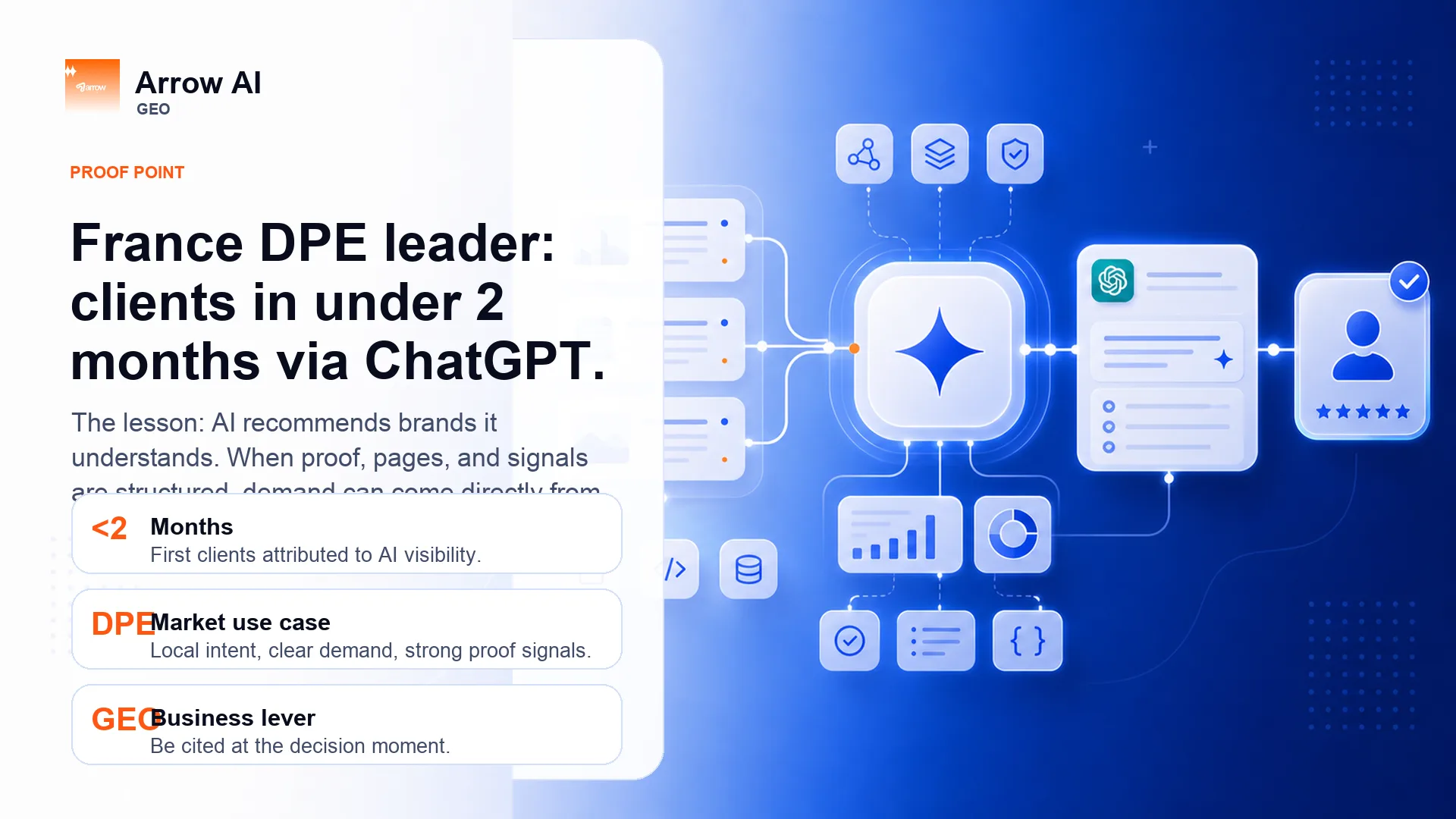
Companies need AI visibility because buyers now ask AI systems to compare providers, explain options, check trust signals, and recommend next steps before they click a website. GEO helps a company become easier to understand, verify, and cite at the exact moment a buyer is deciding who to contact.
For years, being found meant ranking in Google, running paid ads, posting on social, or waiting for referrals. Those channels still matter. But the buyer journey has changed. A prospect can now ask ChatGPT, Perplexity, Gemini, or Google AI a question that used to belong to sales: who should I trust, what is the best option, what does it cost, what documents do I need, which provider fits my situation, and what are the risks?
That shift creates a simple problem. If the AI system cannot understand your company, cannot verify your offer, and cannot find useful public context about your category, it may ignore you. Not because your company is bad, but because the answer engine has nothing clear to work with.
What the France DPE example proves
The France DPE example is useful because it is not abstract. It shows how a local, high-intent service category can create demand when the market has a clear question, a real urgency, and a business that can be described in public terms.
Without exposing confidential process details, the lesson is this: a DPE-related buyer does not always start with a brand name. They may ask what a DPE is, when it is required, how to choose a provider, what happens before a sale or rental, how long it takes, what documents are needed, or who can help in a specific area. If the company has answer-ready pages, proof signals, local context, and clear next steps, AI systems have a better chance of connecting that buyer intent to the company.
The point is not to claim guaranteed rankings in AI systems. Nobody serious should promise that. The point is to make the business easier to read, cite, and trust across search engines, AI assistants, and human buyers.
What being visible in AI answers really means
AI visibility is not just showing up once in a screenshot. It is a system of public signals that help machines and humans understand what a company does. That includes service pages, comparison pages, FAQ pages, use cases, local pages, author context, schema, internal links, proof, reviews, case studies, and clean CTAs.
Google's own search documentation still recommends helpful, people-first content, clear page structure, and accessible crawling foundations. Schema.org provides public vocabulary for entities such as LocalBusiness and FAQPage. AI answer engines are different from classic SEO, but they still need clear sources. The companies that win are usually the ones that make the answer easier to verify.
This is where Arrow AI GEO connects to sales. GEO content should not live as a disconnected blog project. It should point to the offer, the proof, the industry page, the booking path, and the CRM. Visibility only matters if it can become qualified demand.
Industry examples that make the case clear
Different industries have different buyer questions. That is why one generic article about AI visibility is not enough. GEO works when the company maps the questions that matter in its category and turns them into useful, answer-ready assets.
Real estate and DPE
Buyers ask about diagnostics, compliance, selling timelines, rental rules, renovation impact, and provider trust. Pages should explain the situation clearly and route the lead to the right next step.
Legal services
Prospects ask what documents they need, which practice area applies, how urgent the issue is, and what a first call should cover. GEO pages can support intake without giving legal advice.
Yacht brokers and charter
Buyers need trust before they book or buy. Useful pages explain APA, deposits, survey, sea trial, escrow, crew, itinerary, insurance, reviews, and broker proof.
Nutrition and wellness
Users ask about program fit, meal planning, motivation, progress tracking, onboarding, and support. Visibility matters when the experience is educational, credible, and conversion-aware.
B2B SaaS and services
Buyers ask for alternatives, comparisons, pricing context, integrations, use cases, limitations, and implementation timelines. These are decision pages, not filler content.
Ecommerce
Shoppers ask product questions, compare options, check delivery, returns, compatibility, materials, and reviews. Answer-ready product content can reduce doubt before checkout.
A safe process that does not reveal sensitive details
The public process can be explained without revealing the full operating system. Start by listing the questions buyers already ask. Group them by category: awareness, comparison, local intent, cost, proof, objections, implementation, and urgency. Then decide which pages deserve to exist because they help a real buyer make a better decision.
Next, build the content structure: a direct answer, context, proof, practical examples, FAQs, internal links, and a conversion path. Add schema where it is appropriate. Link the pages into the broader site so Google, AI engines, and users can understand the relationship between the brand, the offer, and the industry.
Finally, track what happens. Use Arrow Signal or your own reporting layer to connect AI visibility work to prompts, indexed pages, branded searches, clicks, forms, HubSpot activity, calls, and pipeline. The goal is not vanity visibility. The goal is qualified attention.
AI visibility is becoming a trust layer.
When buyers ask an AI system who to trust, the answer is built from available context. Companies that publish clear, factual, useful pages have a better chance of being understood. Companies that hide their expertise behind vague homepages leave the answer engine to guess.
What not to do
Do not publish thin pages just to target prompts. Do not make fake guarantees about ranking inside ChatGPT or Perplexity. Do not expose client data, private workflows, or operational details that should remain confidential. And do not treat GEO as a one-time blog push. It is a visibility system that needs strategy, structure, updates, proof, and conversion tracking.
For more context, read the France DPE GEO case study, the local GEO guide for service businesses, and the AI visibility to qualified leads framework.