 Arrow
Arrow 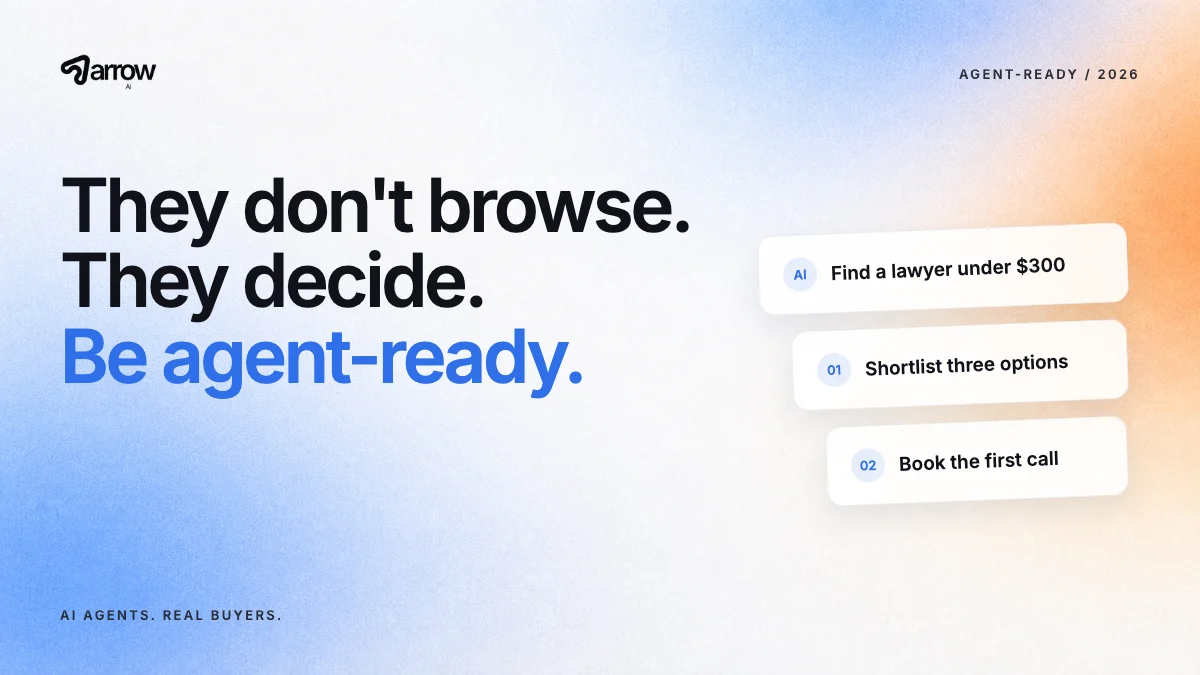
Buyers now delegate research to AI agents that compare, filter and book. An agent-ready business publishes its offer, audience, price, location, next step and proof in a form a machine can verify. If an agent cannot check a fact, it moves on to the next option.
- 1. Understand the request
- 2. Shortlist vendors
- 3. Verify the facts
- 4. Act or hand off
What is an agent-ready business?
An agent-ready business is one that an AI agent can understand, compare and act on without a human filling the gaps. The agent may be ChatGPT agent, an AI browser such as Perplexity Comet or a booking feature in Google AI Mode. The test is the same: when a buyer delegates a task, can the agent find what you offer, check that it fits, see what it costs and take the next step?
This is a different job from being mentioned in an AI answer. A mention gets you seen. An agent decides which options survive the shortlist, which form it fills and which booking it proposes. If a fact is missing or contradictory, the agent cannot ask your sales team. It usually moves on to an option it can verify.
Agent-ready = the facts a buyer needs, published in a form a machine can read and act on.
What changed in 2025 and 2026?
AI assistants moved from answering to acting. OpenAI introduced ChatGPT agent, which uses its own virtual browser to navigate sites, fill forms and complete multi-step tasks while asking for permission before consequential actions. Perplexity's Comet browser puts an assistant inside the browser that can compare products and fill forms. Google started rolling out agentic booking for restaurants, events and appointments in AI Mode.
Commerce followed. OpenAI and Stripe published the Agentic Commerce Protocol, an open standard that lets a buyer complete a purchase inside ChatGPT with eligible merchants.
None of these features cover every business, country or plan yet. The direction is clear, though: more of the research and the first action will happen before the buyer ever lands on your homepage.
How does an AI agent choose a business?
An agent follows a task, not a keyword. It interprets the request, builds a list of candidates, checks each against the constraints and then acts or hands the decision back to the person.
| Step | What the agent does | What it needs from you |
|---|---|---|
| Understand | Turns "find a family lawyer in Austin under $300 for a first call" into constraints | Plain words for your services and audience |
| Shortlist | Finds candidates through search and known sources | Pages that can be found and crawled |
| Verify | Checks price, location, availability and proof | Facts in visible text, consistent everywhere |
| Act | Fills a form, starts a booking or reports back | A next step it can complete or explain |
The full breakdown of these checks is in how AI agents shortlist vendors.
Which facts should you publish first?
Start with the facts that decide eligibility. An agent asked to respect a budget, a location and a deadline will drop any option it cannot test against those three constraints.
| Priority | Fact | Where it should live |
|---|---|---|
| 1 | What you offer, in one sentence | Homepage and each service page |
| 2 | Who it is for and who it is not for | Service pages |
| 3 | Price, starting price or price logic | A crawlable pricing page |
| 4 | Location, service area and hours | Contact or location pages |
| 5 | How to book, buy or enquire | A form that works without hidden steps |
| 6 | Proof: reviews, cases, credentials | Pages with dates and names |
Use the pricing guide and the booking guide for the two items that most often block an agent.
Is this different from GEO and SEO?
It builds on both. SEO helps your pages get found. Generative engine optimization helps AI answers describe and cite you accurately. Agent readiness adds a third requirement: the information must be complete enough to support a decision and an action.
A page can rank well and still fail an agent. A beautiful service page with no price, no service area and a booking widget that only loads after three clicks is readable by a patient human. An agent working through ten options has less reason to persist.
How do you get started this week?
Pick the three tasks a buyer is most likely to delegate, such as "compare three providers", "check the price" and "book a first call". Run each one yourself in an AI assistant with agent features, record where it stops, then fix the missing fact or the broken step.
The 15-point agent-ready checklist turns this into a repeatable review. For the technical layer, read schema markup for AI agents and how to track AI agent traffic.
Arrow AI helps businesses see what AI systems can find about them today. A free GEO audit is a starting point for spotting the facts an agent cannot verify yet.
Sources and editorial scope
Reviewed October 1, 2026. Platform-specific statements link to the documentation beside the claim. The workflows and examples are Arrow AI editorial guidance. Agent features change quickly and vary by plan and country; check the linked documentation before acting. Fictional scenarios illustrate a method; they are not customer results, measured demand or evidence of ranking gains.
- OpenAI introduced ChatGPT agent
- Perplexity's Comet browser
- agentic booking for restaurants, events and appointments in AI Mode
- Agentic Commerce Protocol
Part of Agent-Ready Business. Explore Arrow GEO or request a free audit to see which facts an AI agent can already find about your business.