 Arrow
Arrow 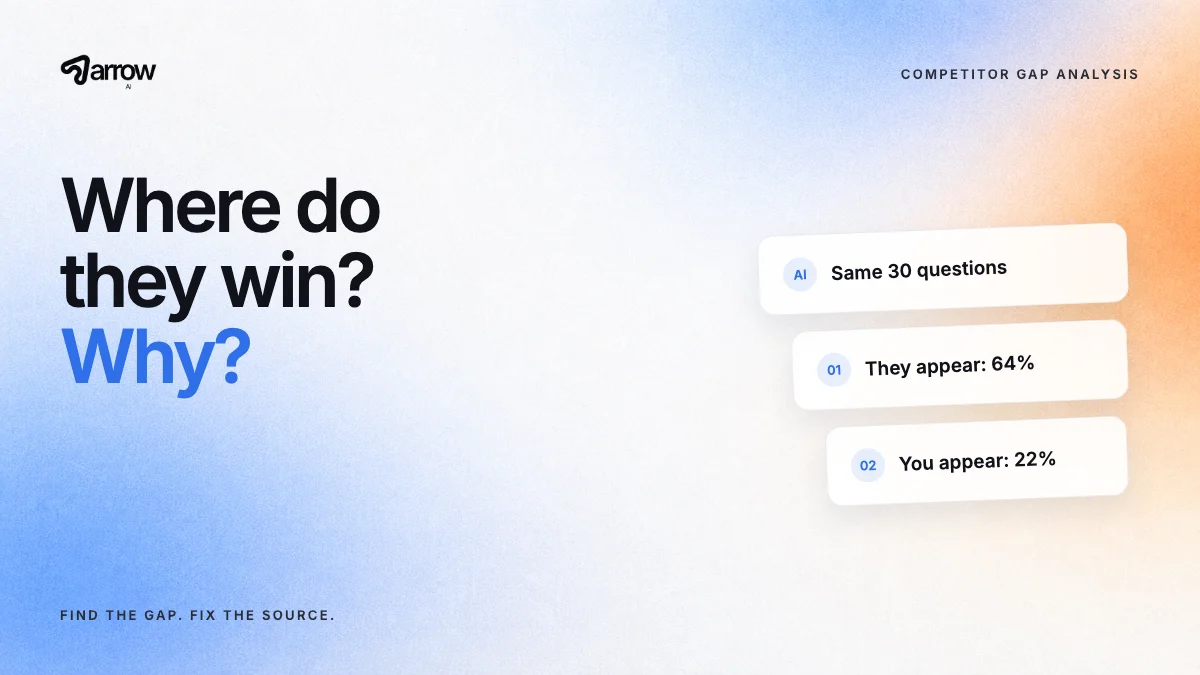
Run the same buyer questions for you and your competitors, several times each. Record who appears and which sources the AI cites. The gaps show exactly which pages, proof or mentions you are missing.
What is an AI visibility competitor gap analysis?
It is a side-by-side comparison of how often AI assistants include you and your competitors for the same buyer questions. The gaps are the questions where competitors appear and you do not. Each gap points to something missing: a page, a piece of proof, a clear positioning statement or independent coverage.
How do you run one, step by step?
1. Pick three to five competitors. Choose the brands buyers actually compare you with, not the biggest names in the industry.
2. Write 20 to 40 buyer questions. Mix stages: discovery ("best accounting firm for startups in Austin"), comparison ("X vs Y") and decision ("is X worth it for a 10-person team?"). Use the words customers use in sales calls and emails.
3. Run each question several times. Use the assistants your buyers use and repeat each question three to five times. AI answers vary between runs, so a single answer is not enough.
4. Record who appears and which sources are cited. One row per answer, one column per brand, plus the cited domains.
5. Calculate presence per question. For each question, compare your presence rate with each competitor's.
How do you read the results?
Sort the questions into four groups.
| Group | What it means | Action |
|---|---|---|
| You win | You appear more often than competitors | Protect: keep pages and proof current |
| Shared | You and competitors appear similarly | Differentiate: sharpen your specific fit |
| Gap | Competitors appear, you rarely do | Investigate the sources cited |
| Empty | Nobody appears consistently | Opportunity: publish the clearest answer |
Prioritise gaps by commercial value. A gap on a question close to purchase, such as "best [service] for [your ideal customer]", is worth more than a gap on a broad educational question.
How do you find out why a competitor wins?
Look at the cited sources and the reasons the answer gives. Common patterns:
| Pattern in the answer | Likely cause | Fix |
|---|---|---|
| Competitor cited from review sites | They have more independent reviews | Encourage reviews on the sites cited |
| Competitor's comparison page cited | They published the comparison you did not | Publish a fair comparison page |
| Specific fit stated ("best for X") | Their pages name that audience clearly | State your fit in plain words |
| Industry article cited | They earned coverage | Plan targeted PR |
Arrow's guide why AI recommends your competitors covers these causes in more detail, and how to build comparison pages helps with the most common fix.
What does a good gap report look like?
One page per month: the question set, presence rates for you and each competitor, the top five gaps by commercial value, the sources cited in those gaps and the action assigned to each. Keep the question set fixed so you can see whether a gap closes. Report trends across several months rather than single-month swings, because AI answers fluctuate.
Use AI share of voice for the overall number and this analysis for the specific actions.
Sources and editorial scope
Reviewed October 5, 2026. Platform-specific statements link to the documentation beside the claim. The workflows and examples are Arrow AI editorial guidance. AI answers vary between runs and change over time; studies cited here describe their own samples. Fictional scenarios illustrate a method; they are not customer results, measured demand or evidence of ranking gains.
Part of AI Share of Voice. Explore the Arrow AI visibility platform or request a free audit to see how often AI includes your brand today.