 Arrow
Arrow 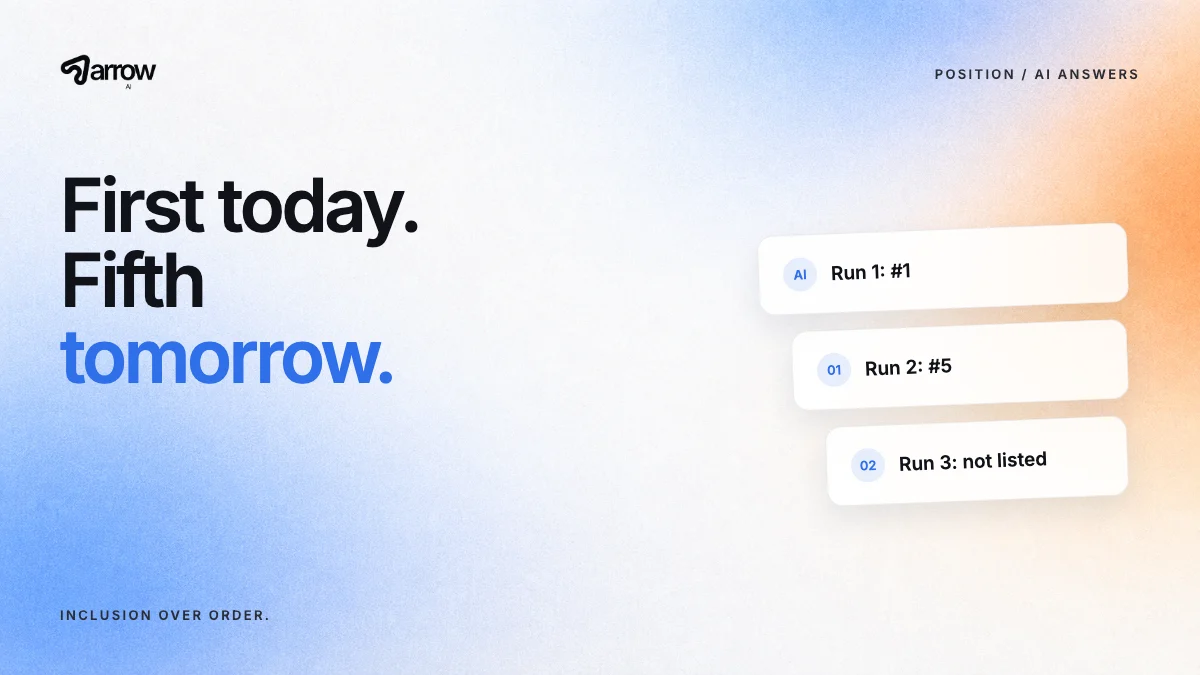
AI answers reshuffle brands on almost every run, so a single rank is misleading. Measure how often you appear and how you are described. Position matters most when the answer names one clear pick.
Does it matter where your brand appears in an AI answer?
Less than most dashboards suggest. AI answers reorder brands on almost every run, so a single position is a weak signal. Research by SparkToro and Gumshoe across ChatGPT, Claude and Google AI Overviews found that two responses to the same prompt almost never listed the same brands, and the same order repeated even less often. How often you appear is a steadier measure than where you appear.
Why are AI rankings so unstable?
AI assistants generate each answer fresh. Small differences in sampling, retrieved sources, the user's location and the conversation context change which brands are named and in what order. The number of brands listed also varies: one answer may name three, the next ten.
That is why "we rank #1 in ChatGPT" claims deserve caution. Ask how many runs, on which date, in which location and with which wording. One screenshot shows what happened once.
When does position still matter?
Position matters most when the answer makes a clear recommendation rather than a list.
| Answer type | Does position matter? | Why |
|---|---|---|
| "The best option is X" | Yes, a lot | One brand receives the recommendation |
| A short list of 2–3 | Somewhat | Each brand gets meaningful attention |
| A long list of 8–10 | Little | Order varies; inclusion matters more |
| A comparison table | Little | Buyers compare columns, not order |
So the useful question is not "what is our rank?" but "how often are we the primary recommendation, how often are we on the list and how often are we absent?"
What should you measure instead of rank?
Measure presence rate, primary-recommendation rate and description quality across repeated runs.
| Measure | Definition |
|---|---|
| Presence rate | Share of answers that include you |
| Primary pick rate | Share of answers where you are the main recommendation |
| Description quality | Whether the reason given for you is accurate and favourable |
| Average list size | How crowded the answers are |
These numbers come from the same run log you use for AI share of voice. The competitor gap analysis shows how to compare them with competitors.
How do you become the primary recommendation more often?
Give the AI a clear reason to pick you for a specific situation. Generic claims such as "the leading platform" rarely help. Specific fit does: "built for dental clinics with two to ten chairs" or "fixed monthly fee, no setup cost". When the buyer's question matches a specific fit you state and prove, you are a more natural primary pick for that question.
Pair that with proof the AI can find elsewhere: reviews, case studies and independent coverage that repeat the same positioning.
Sources and editorial scope
Reviewed October 5, 2026. Platform-specific statements link to the documentation beside the claim. The workflows and examples are Arrow AI editorial guidance. AI answers vary between runs and change over time; studies cited here describe their own samples. Fictional scenarios illustrate a method; they are not customer results, measured demand or evidence of ranking gains.
Part of AI Share of Voice. Explore the Arrow AI visibility platform or request a free audit to see how often AI includes your brand today.