 Arrow
Arrow 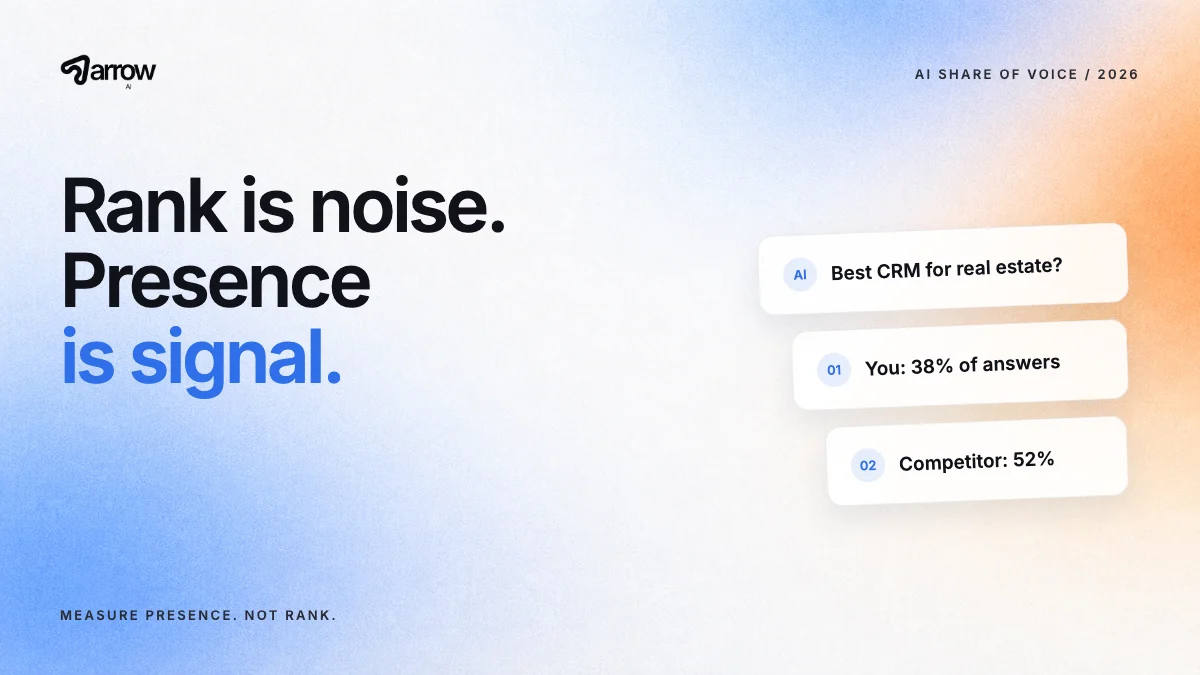
Your share of voice in AI is how often assistants include you when buyers ask about your category. Measure presence across many runs, not a single rank, because answers change every time. Grow it with consistent, sourced descriptions across the web.
- 1. Fix the questions
- 2. Repeat the runs
- 3. Compare with competitors
- 4. Close the gaps
What is AI share of voice?
AI share of voice is the percentage of relevant AI answers that include your brand, compared with the competitors buyers consider alongside you. If ChatGPT, Gemini, Claude or Perplexity answer fifty questions about your category and your brand appears in twenty of them, your presence rate is 40%. Share of voice puts that number next to your competitors' rates for the same questions.
It answers a simple commercial question: when buyers ask AI about our category, how often are we part of the answer?
Why not just track your rank?
Because AI answers do not keep a stable order. SparkToro and Gumshoe ran 2,961 prompts through ChatGPT, Claude and Google AI Overviews and found less than a 1-in-100 chance that two responses would contain the same list of brands. The order repeated even less often.
The same research suggests a more useful measure: across many runs, how often a brand appears shows how strongly the AI associates it with the question. That is share of voice. A screenshot showing you "ranked first" once proves very little; appearing in 60% of fifty runs is a pattern.
How do you calculate it?
Use a fixed set of buyer questions, run each several times and record every brand named.
| Step | What to do | Example |
|---|---|---|
| 1. Choose questions | 20–50 real buyer questions for your category | "Best payroll software for a 30-person company" |
| 2. Choose assistants | The ones your buyers use | ChatGPT, Google AI Mode, Perplexity |
| 3. Repeat runs | Run each question 3–5 times per assistant | 50 questions × 3 runs × 3 assistants = 450 answers |
| 4. Record brands | Every brand named in each answer | You, Competitor A, Competitor B… |
| 5. Calculate | Answers including a brand ÷ total answers | You 38%, A 52%, B 21% |
The figures are illustrative. Keep the questions, assistants, location and dates fixed so the next measurement is comparable. Arrow's prompt tracking guide covers the record-keeping in detail.
What should you measure alongside share of voice?
Presence is the headline, not the whole picture. Add four companion measures:
| Measure | The question it answers | Guide |
|---|---|---|
| Mentions vs citations | Are we named, linked, or both? | Mentions vs citations |
| Sentiment | Is the description accurate and favourable? | AI brand sentiment |
| Position | Are we the main pick or one of many? | Does position matter? |
| Gaps | Which questions do competitors win? | Competitor gap analysis |
How do you grow your share of voice?
Make it easy for AI systems to associate your brand with the question, from sources they trust. Three levers matter most.
Clear owned pages. Pages that state what you do, for whom and with what proof, in plain words. Start with the quick wins list.
Independent mentions. Ahrefs' study of 75,000 brands found branded web mentions correlated more strongly with AI Overview visibility than backlinks did. Correlation is not proof of cause, but it points to the value of being discussed on other sites. See does PR improve AI visibility?.
Consistency. The same name, description and facts across your site, profiles and directories, so AI systems do not split or confuse your identity.
How often should you measure?
Monthly is enough for most companies. AI answers move with model updates and new sources, so a single month's change can be noise. Look for trends over two or three measurements before drawing conclusions, and record any major change you made in between.
Arrow AI tracks how assistants describe and recommend brands across the questions buyers ask. A free AI visibility audit gives you a first baseline.
Sources and editorial scope
Reviewed October 5, 2026. Platform-specific statements link to the documentation beside the claim. The workflows and examples are Arrow AI editorial guidance. AI answers vary between runs and change over time; studies cited here describe their own samples. Fictional scenarios illustrate a method; they are not customer results, measured demand or evidence of ranking gains.
Part of AI Share of Voice. Explore the Arrow AI visibility platform or request a free audit to see how often AI includes your brand today.