 Arrow
Arrow 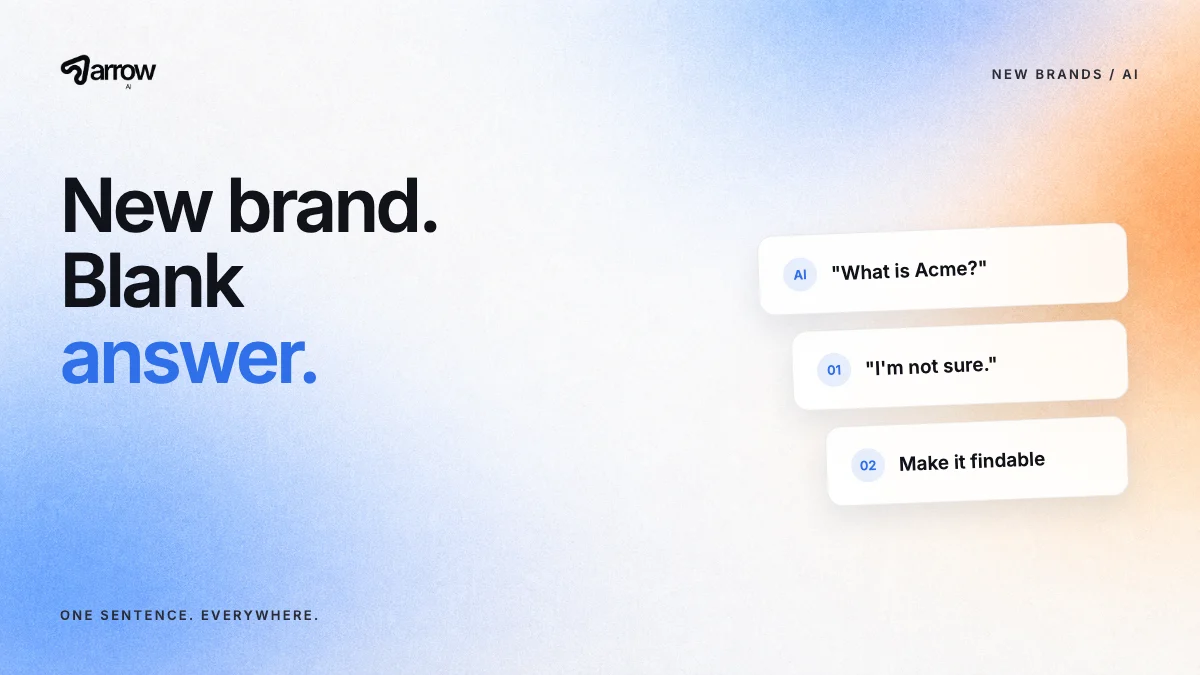
New brands are often missing from AI training data and weakly described in live search results. A clear website, consistent profiles and a few independent mentions are the first steps to being recognised.
Why doesn't ChatGPT know my brand?
Usually because there is not yet enough clear, consistent information about your brand in the places AI assistants learn from and search. AI models are trained on text up to a cut-off date, so a company founded or renamed after that date may be missing from the model's memory. When the assistant searches the web live, it can find you only if your pages are reachable and clearly describe who you are, and it trusts you more when other sites say the same thing.
What is the difference between training data and live search?
| Training data | Live search | |
|---|---|---|
| When it is collected | Before the model is released | At the moment of the question |
| Can a new brand appear? | Only if it existed and was discussed before the cut-off | Yes, if pages can be found and read |
| What helps | Being widely discussed over time | Clear pages and consistent sources today |
| How fast it changes | With new model versions | As the web and indexes update |
OpenAI explains that ChatGPT search can provide answers with links to current web sources. That is the fastest route for a new brand: be findable and unambiguous for live search while your broader footprint grows.
What should a new company do first?
Work through these steps in order.
1. One sentence that says what you are. "Acme is a payroll platform for restaurants in Texas." Put it on your homepage, About page and every profile.
2. A clear About page. Founding date, founders, location, what you do, who you serve. Arrow's guide on what your About page should say gives a template.
3. Consistent profiles. LinkedIn company page, Google Business Profile where relevant, Crunchbase or industry directories, all using the same name and description.
4. Pages that answer buyer questions. One page per service or use case, written answer-first.
5. A few independent mentions. A local news story, a podcast, a partner's case study or an industry directory. Independent sources confirm you exist and what you do.
6. Crawler access. Make sure your site does not block the search crawlers you want to reach you; see which AI crawlers to allow.
What if AI confuses you with another company?
Name collisions are common for new brands. Use your full name with a distinguishing detail ("Acme Payroll, Austin") consistently, link your profiles to each other and to your domain, and add Organization schema with your official URL and profiles. The guide why AI confuses your business with another company covers the fix in detail.
Do you need a Wikipedia page?
Usually not at the start, and you cannot simply create one: Wikipedia requires independent, reliable coverage. Focus first on your own site, profiles and earned mentions. Read do you need a Wikipedia page for AI?.
How do you know it is working?
Ask assistants with web search enabled, "What is [brand]?" and "Who are the best [category] providers in [location]?" every month. Record whether you are recognised, whether the description is correct and which sources are cited. Recognition on branded questions usually comes before presence on unbranded ones. Track both with the AI share of voice method.
Sources and editorial scope
Reviewed October 5, 2026. Platform-specific statements link to the documentation beside the claim. The workflows and examples are Arrow AI editorial guidance. AI answers vary between runs and change over time; studies cited here describe their own samples. Fictional scenarios illustrate a method; they are not customer results, measured demand or evidence of ranking gains.
Part of AI Share of Voice. Explore the Arrow AI visibility platform or request a free audit to see how often AI includes your brand today.